
The octopus, a brain in eight arms: what its captivity demands of us
Common octopus farming is now technically feasible. Three recent studies, on skin microbiome, larval nutrition and laboratory culture, sketch what dignified captivity means for one of the most intelligent invertebrates.
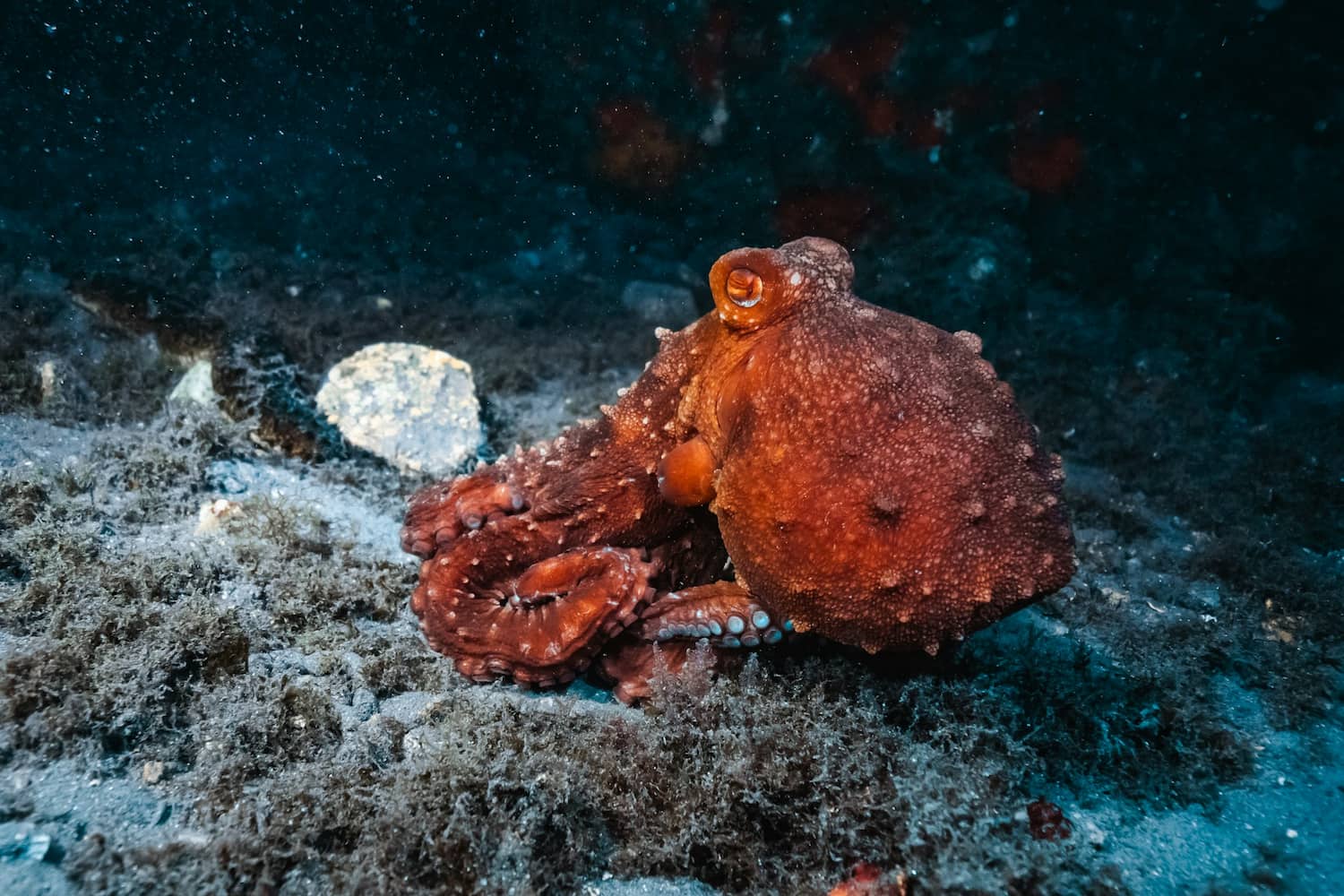
Photo: Dani Grau
In 30 seconds: the common octopus (Octopus vulgaris) solves problems, learns by watching and remembers; farming it became viable once researchers closed its life cycle in captivity; three recent studies show how to read its welfare through skin bacteria, how to reduce oxidative stress in paralarvae and what minimum conditions a captive cephalopod needs.
An animal that maps its space
An octopus in a tank does not rest. It works the perimeter with its arms, fingers the seams of the acrylic, tests the lid, logs every ledge. Given a mechanism, it manipulates it. Given a crevice, it evaluates it. This behavior is active exploration. Octopuses display cognitive abilities we usually reserve for vertebrates: tool use, problem solving, observational learning and episodic memory1.
That intelligence makes the octopus an uncomfortable candidate for aquaculture. Farming sea bass raises questions of density, feed and slaughter. Farming an animal that inspects its surroundings and learns from them adds a harder one: what kind of captivity does a mind like this deserve.
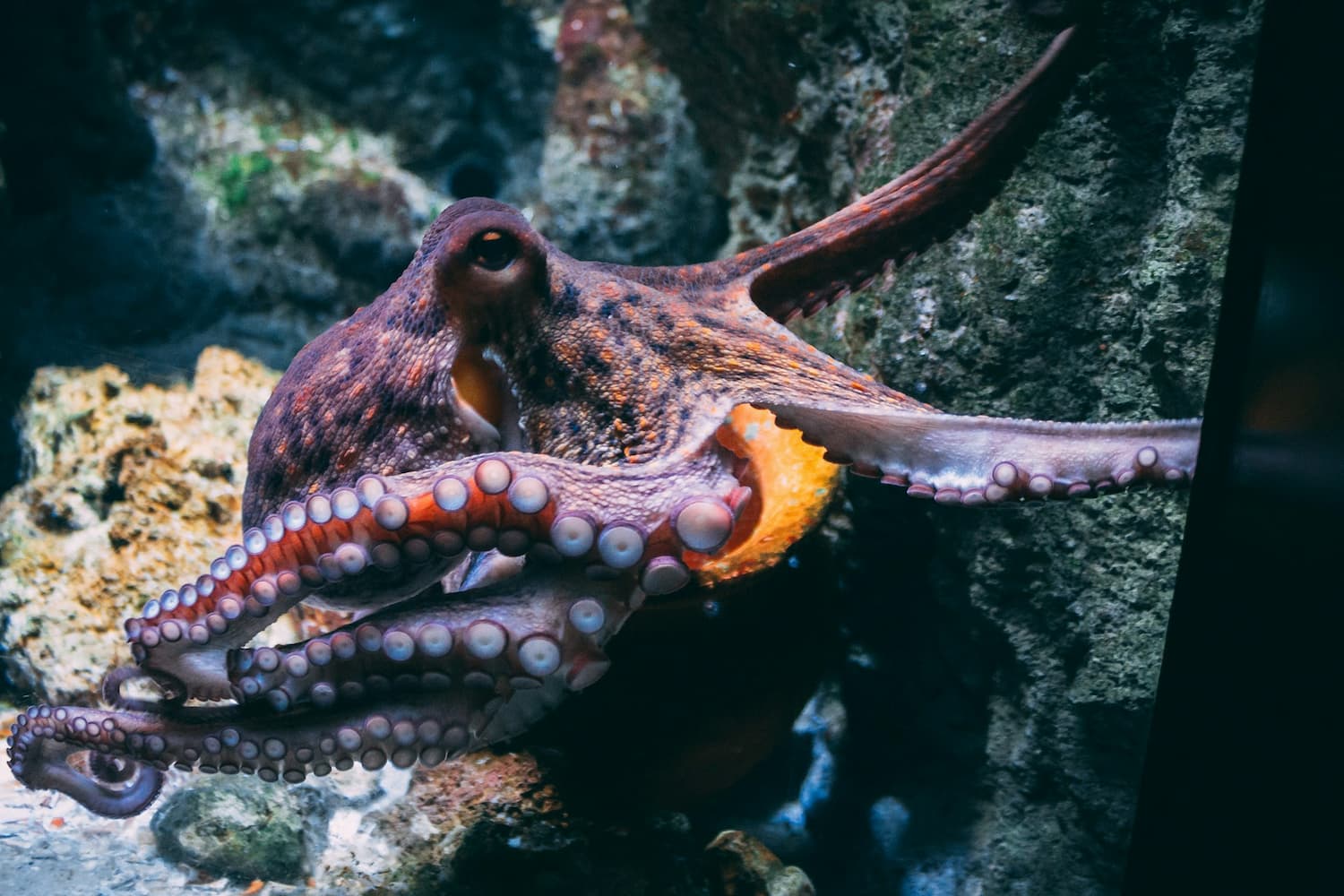
Photo: Diane Picchiottino (https://unsplash.com/it/@diane_soko)
Octopus farming is no longer hypothetical
Interest in farming Octopus vulgaris has grown for a decade, pushed by market demand, declining fisheries and the search for more controlled sources of marine protein2. On paper, the common octopus looks promising: fast growth, a short life cycle, good adaptability to captivity and high nutritional and economic value2.
For years, one obstacle blocked everything: the paralarvae (the first life stage after hatching, during which the young octopus is planktonic, drifting in the water column). Mortality in this stage was massive, largely because the live prey used as feed was nutritionally deficient2. That bottleneck loosened when scientists at the Spanish Institute of Oceanography and the Pescanova Biomarine Center in Galicia developed a rearing technique that closed the species’ full life cycle in captivity2. With the cycle closed, industrial-scale farming stopped being science fiction.
The same research that celebrates the advance warns of growing concern about the impact of intensive, large-scale production2. The debate now turns on the conditions we are willing to accept.
The microbiome: a non-invasive window into welfare
Measuring stress in an octopus is hard. In vertebrates, glucocorticoids (steroid hormones) regulate the physiological stress response and serve as indicators; in cephalopods, the equivalent neuroendocrine mechanisms remain unclear, which blocks that route2. Octopuses also edit their own RNA with remarkable capacity, which blurs transcriptomic studies: the link between DNA sequence and expressed protein becomes hard to read2.
In 2024, a team at the Institute of Marine Research (IIM-CSIC) proposed an alternative: read the bacterial community of skin mucus as a biomarker of health and welfare. They compared the skin microbiome (the community of microorganisms living on the skin) of ten wild octopuses from the Ría de Vigo with that of ten fifth-generation captive-bred animals kept in tanks with cognitive enrichment2.
The octopus’s core skin microbiota is dominated by the phyla Bacteroidota and Pseudomonadota, with Aurantivirga, Pseudofulvibacter and Rubritalea as the most abundant genera, and that composition stays similar between wild and farmed animals2. Wild octopuses carried more potentially pathogenic bacteria, such as Vibrio spp., Photobacterium swingsii and Lactococcus garvieae, less frequent or absent in the aquaculture group2. The authors read the data as a sign that the center’s controlled conditions, with high-quality water, support animal welfare2.
The finding offers a concrete, non-invasive tool to audit an octopus’s condition without sacrificing or stressing it, and shows that the debate over cephalopod farming can rest on concrete measurements.
Paralarvae: the bottleneck is also ethical
If octopus farming has a weak point, it sits in the first thirty days of life. Paralarvae are planktonic, tiny and demanding: they need live prey, and the only viable option at scale is Artemia (brine shrimp, a small crustacean widely used in aquaculture), which is easy to produce but nutritionally insufficient on its own3.
A 2025 study by several Spanish research centers tested enriching Artemia with two natural bioactive compounds: an olive extract rich in hydroxytyrosol (a polyphenol with antioxidant properties) and black cumin seed oil, rich in thymoquinone (a compound with anti-inflammatory and antioxidant effects)3. Paralarvae fed those diets showed less lipid peroxidation (oxidative damage to cell membranes) at thirty days, meaning less cellular oxidative damage, with no differences in growth or survival against the control group3. In the black cumin group, activity of the enzyme glutathione S-transferase (an enzyme involved in detoxification) dropped, which suggests a lower need for detoxification because oxidative stress was lower3.
This is the first demonstration that hydroxytyrosol and thymoquinone metabolites transfer from Artemia to octopus paralarvae3. Even in the animal’s most fragile stage, diet can reduce physiological suffering. High larval mortality is also a welfare problem with room for improvement.
What a laboratory octopus teaches us
While aquaculture looks for scale, basic science looks for a model. At the Marine Biological Laboratory in Woods Hole, a team achieved in 2021 the first multigenerational culture of Octopus chierchiae, the lesser Pacific striped octopus: a small cephalopod, 20 to 30 millimeters of adult mantle length (the main body part, excluding arms), that reaches sexual maturity around six months and, unlike most octopuses, lays several clutches over its lifetime1.
The paper states frankly what keeping cephalopods in captivity requires. Octopuses have fast metabolisms and produce heavy waste, so water quality needs constant monitoring1. They are skilled escape artists, so enclosures need specific designs1. Cannibalism is common in many species: individual enclosures remain the most ethical option to prevent attacks and stressful interactions between neighbors1. The team even installed opaque visual barriers between tanks so the animals could not see each other1.
The result: three generations raised in the laboratory, with 14 to 15 percent of animals surviving beyond four hundred days in the first two1. The lesson goes beyond the species. If a leading laboratory needs that level of detail (enclosure design, density, visual isolation, live diet) to keep octopuses healthy, intensive cephalopod farming cannot afford lower standards.
The minimum we should demand
The three studies point the same way: octopus welfare in captivity is measurable, improvable and enforceable. Translating that into concrete conditions makes sense before the industry sets its own standards.
- Real environmental enrichment. The tanks in the microbiome study included cognitive enrichment structures2. An animal that explores needs something to explore.
- Individual housing where the species requires it. Cannibalism and stress from visual contact justify it1.
- Continuously monitored water quality. Octopus metabolism leaves no room for improvisation1.
- Non-invasive biomarkers. The skin microbiome already works as an indicator of health and welfare2. Using it should become standard practice.
- Larval nutrition as a welfare issue. Reducing oxidative stress in paralarvae is possible with documented dietary enrichments3.
- Debate before industrialization. The researchers who made farming possible ask that animal welfare be a core axis of this aquaculture’s development2.
Aquaculture history is full of species that were industrialized first and protected later. The octopus offers the opposite chance: we know enough about its intelligence and physiology to design the system before scaling it.
A question for the reader
If an octopus can map the space it lives in, what are we offering it to map?
Sources
Footnotes
-
Grearson, A. G., et al. (2021). “The Lesser Pacific Striped Octopus, Octopus chierchiae: An Emerging Laboratory Model.” Frontiers in Marine Science, vol. 8. DOI: 10.3389/fmars.2021.753483 ↩ ↩2 ↩3 ↩4 ↩5 ↩6 ↩7 ↩8 ↩9
-
Costas-Imbernón, D., et al. (2024). “The skin microbiome as a new potential biomarker in the domestication and health status of Octopus vulgaris.” Frontiers in Marine Science, vol. 11. DOI: 10.3389/fmars.2024.1435217 ↩ ↩2 ↩3 ↩4 ↩5 ↩6 ↩7 ↩8 ↩9 ↩10 ↩11 ↩12 ↩13 ↩14
-
Martín, M. V., et al. (2025). “Effect of natural bioactive compounds on growth and welfare in Octopus vulgaris paralarvae.” Frontiers in Marine Science, vol. 12. DOI: 10.3389/fmars.2025.1629293 ↩ ↩2 ↩3 ↩4 ↩5 ↩6
Topics
Newsletter
A weekly reading to see the aquatic world with clearer judgment.
Receive short, carefully edited reflections on aquatic life, ethical aquarium keeping, and applied science.
Subscribe