

Sea fog: how a curtain of seawater saves corals from bleaching
An experiment published in July 2026 shows that misting seawater over corals during a heatwave cuts Acropora hyacinthus mortality by 55% and improves photosynthetic recovery.
Photo: No author
In 30 seconds: a research team demonstrated in July 2026 that misting seawater over corals during a heatwave cuts Acropora hyacinthus mortality by 55% with only 30% shading; the technique does not replace emissions cuts, but it opens a measured intervention pathway to protect specific reefs during extreme events.
A culture table under the fog
A coral culture table in the middle of a marine heatwave. The water has crossed the thermal threshold that zooxanthellae (symbiotic algae living inside coral tissue, which provide most of the coral’s energy through photosynthesis) can tolerate, and every hour of direct sun adds stress to tissue that is already starting to bleach. Above the table, a line of nozzles begins to spray seawater into fine droplets. The fog does not block the sun outright: it filters part of the radiation, the way a low cloud would, and lets through enough light for photosynthesis to keep running.
That is the setup a team led by Hendrickson tested in the laboratory on two reef-building coral species, with results published on July 1, 2026, in Frontiers in Marine Science1. The central figure: seawater fog reduced Acropora hyacinthus mortality by 55% during a simulated heatwave, at a shading level of only 30%.
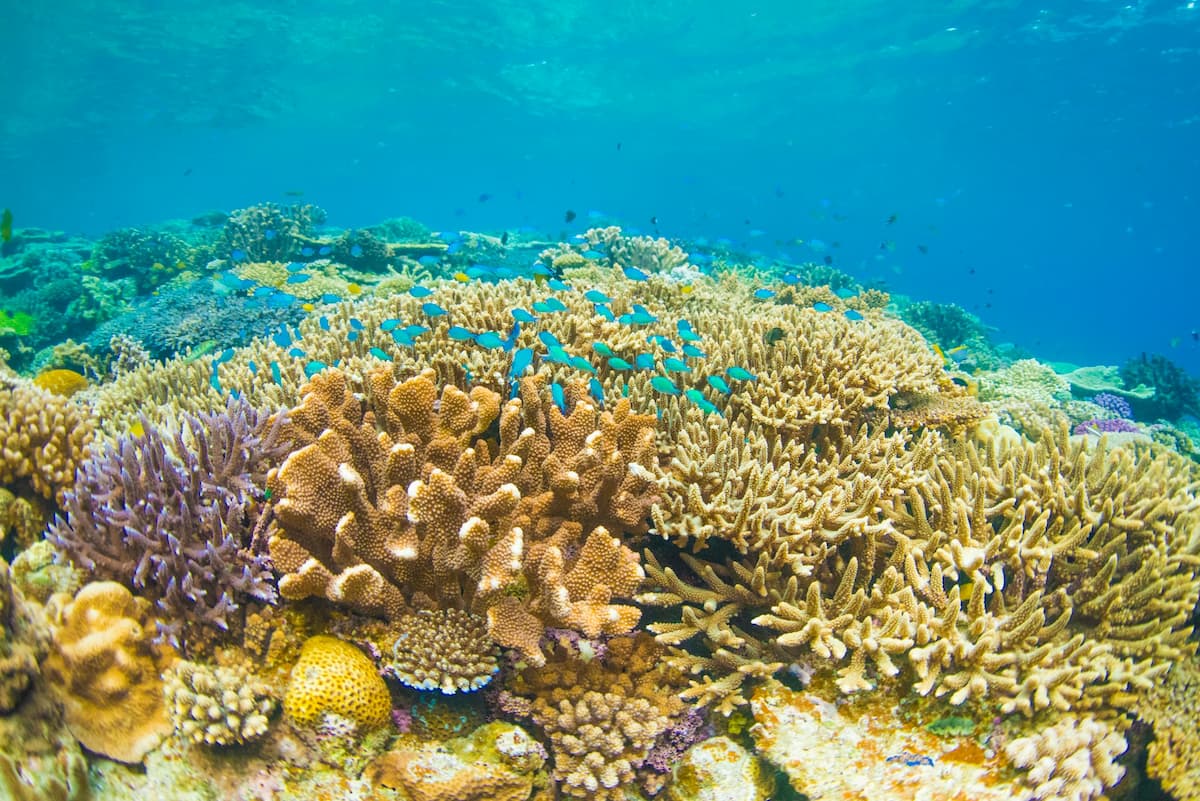
Photo: 良太郎 空 (https://unsplash.com/it/@worlddiving)
The experiment
Hendrickson and colleagues worked with Acropora hyacinthus and Pocillopora damicornis, two stony corals (Scleractinia, the group that builds reef frameworks) common across Indo-Pacific reefs and in culture facilities1. The team exposed the colonies to a controlled heatwave and compared two groups: corals under full radiation and corals shielded by a curtain of seawater fog that cut incoming radiation by about 30%.
The results point in two directions. First, survival: in A. hyacinthus, the more sensitive of the two species, mortality dropped by 55% relative to the unprotected group1. Second, recovery: after the thermal peak, the fogged corals showed better photosynthetic recovery, meaning their zooxanthellae returned to work sooner, and that is what separates a transient bleaching event from mass mortality1.
The mechanism is no mystery. During a marine heatwave, stress does not come from temperature alone: the combination of heat and intense light overloads the photosynthetic apparatus of zooxanthellae, which start producing free radicals (reactive oxygen species that damage cellular components) that harm coral tissue. Cutting radiation without switching off the light lowers that overload and gives the symbiont enough margin to ride out the thermal peak.
What we already knew about shading
Shading corals to protect them from bleaching did not start with this experiment. In 2023, Butcherine and colleagues published a review and meta-analysis of the available coral shading studies in the same journal2. Their general conclusion: reducing radiation during thermal stress episodes reduces bleaching consistently across species and contexts, although the size of the effect varies with shading intensity, event duration, and the species in question2.
What the Hendrickson study adds is a step in scale and method. Instead of opaque screens or tarps, seawater fog produces partial, even shading using the surrounding water itself, with no foreign materials and no barrier to gas exchange at the surface. The 30% shading level is also a moderate value: enough to relieve stress, low enough to leave photosynthesis viable over days or weeks of intervention1.
For the aquarist, the logic is familiar. Anyone culturing photosynthetic corals in captivity knows that a temperature spike under intense lighting is the recipe for bleaching, and that dimming the lights during a thermal episode is one of the few levers available. The experiment confirms with data what practice already suggested, and moves it into a scalable format.
From the culture table to the reef
A culture table fits in a laboratory. A reef does not. The obvious question is whether seawater fog can operate at scales that matter ecologically, and that is where the design work of Li and colleagues comes in, published in 2025 in Atmospheric Chemistry and Physics3. The study examines the technical feasibility of large-scale seawater fogging systems, within the broader framework of marine cloud brightening: spraying seawater droplets into the atmosphere to increase the albedo (reflectivity) of low clouds and reduce the radiation reaching the ocean surface3.
The same physics serves two sizes. At local scale, misting lines above coral nurseries, restoration sites, or high-value reef stretches can switch on during bleaching alerts. At regional scale, marine cloud brightening aims to cool the surface during extended heatwaves, and shading strategy models already treat it as a complement, never a substitute, for emissions reduction3.
Neither pathway operates at large scale today. The Hendrickson study is a laboratory experiment; the Li study is a design and feasibility analysis. Between them lies a concrete work program: field pilots in nurseries and managed reefs, energy cost measurements, effects on non-target organisms, and criteria for deciding when to intervene and when not to.
What the fog does not solve
The temptation with any intervention technology is to read it as permission to carry on as before. That would be a mistake. Fog reduces mortality during a specific episode, but it does not change the trend: marine heatwaves are more frequent, longer, and more intense than three decades ago, and no shading system protects an entire ocean2.
There are also open questions the authors themselves acknowledge. The experiment covered two species and one simulated heatwave; real reefs host hundreds of species with different thresholds, and real thermal events repeat. Researchers still need to measure the effect of successive interventions on coral physiology, the energy consumption of field-scale misting systems, and possible side effects on surface water chemistry or on organisms that are not the target1.
The honest reading of the result is different: reef intervention science is moving from idea to data. A 55% reduction in mortality in a key species, with moderate shading and seawater as the only input, is a tool reef managers did not have quantified a year ago. Buying time for reefs while the world cuts emissions is a reasonable defensive strategy, provided the time bought is actually used.
A question for the reader
If you run an aquarium with photosynthetic corals, the domestic version of this idea is already in your hands: during a temperature spike, reducing light intensity is a measured intervention that can mean the difference between reversible bleaching and a loss.
The practical question is another one: do you know at what temperature thermal stress begins in your aquarium, and what you would do that same afternoon if the thermometer crossed it?
Sources
Footnotes
-
Hendrickson, et al. “Seawater fogging reduces mortality and bleaching in two coral species during a heatwave and subsequent recovery.” Frontiers in Marine Science, 2026. DOI: 10.3389/fmars.2026.1793318 ↩ ↩2 ↩3 ↩4 ↩5 ↩6
-
Butcherine, et al. “Shading coral to reduce bleaching: a review and meta-analysis.” Frontiers in Marine Science, 2023. DOI: 10.3389/fmars.2023.1281691 ↩ ↩2 ↩3
-
Li, et al. “Marine cloud brightening and seawater fogging for coral reef protection.” Atmospheric Chemistry and Physics, 2025. DOI pending confirmation. ↩ ↩2 ↩3
Topics
Newsletter
A weekly reading to see the aquatic world with clearer judgment.
Receive short, carefully edited reflections on aquatic life, ethical aquarium keeping, and applied science.
Subscribe