

The Azorean grouper and the virus that crossed oceans
In 2024 a mass mortality of dusky groupers swept across seven Azorean islands. Phylogenetic analysis reveals the RGNNV virus travelled from the Indo-Pacific, showing how aquaculture and shipping connect viral reservoirs we thought were far away.
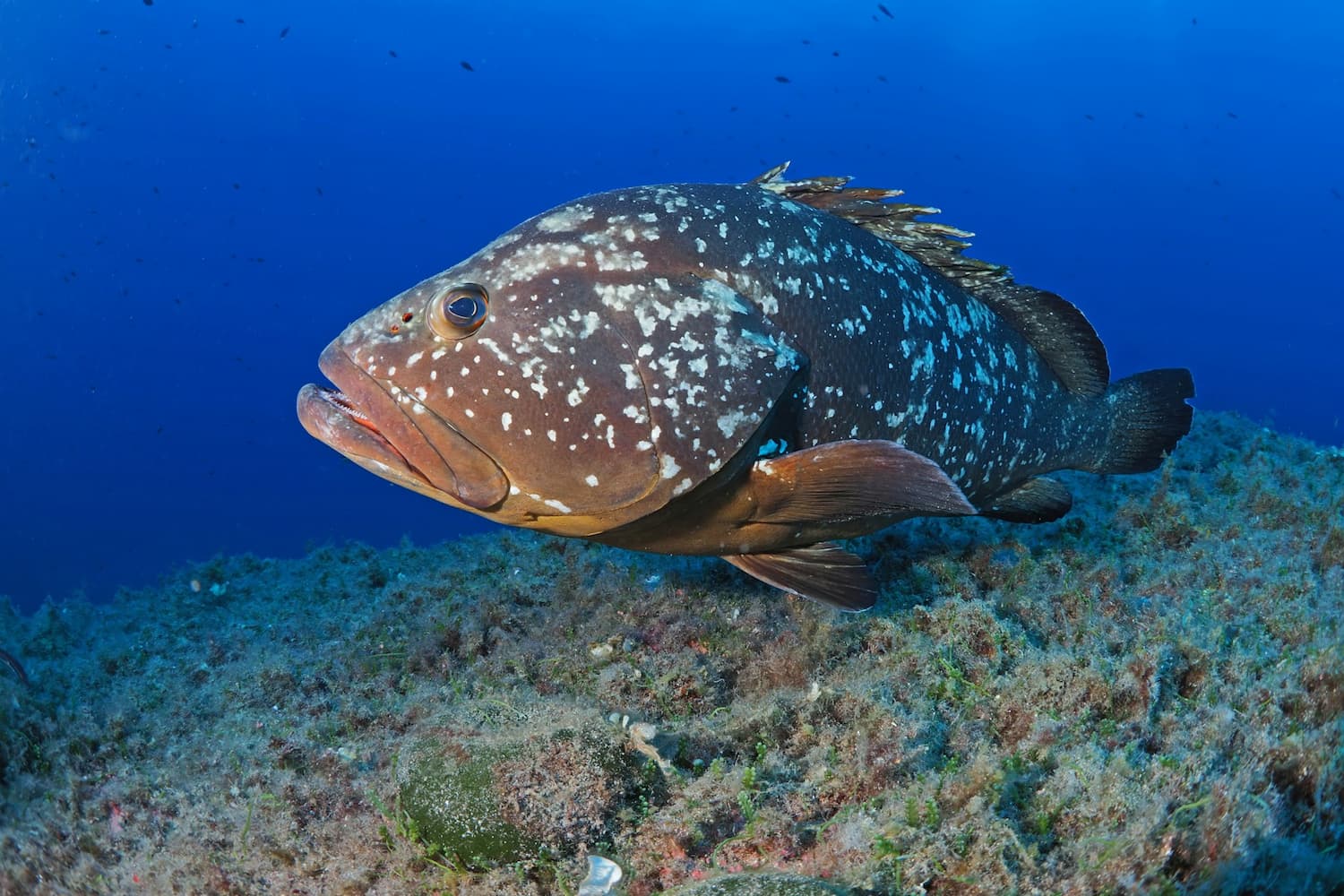
Photo: Pascal van de Vendel (https://unsplash.com/it/@pascalvendel)
In 30 seconds: in 2024 at least 148 dusky groupers (Epinephelus marginatus) died across seven Azorean islands from viral nervous necrosis; a phylogenetic analysis published in July 2026 traces the strain to the Indo-Pacific; globalised aquaculture and shipping now connect distant viral reservoirs and expose isolated wild populations.
A fish found floating belly-up
The dusky grouper is the most charismatic reef fish of the mid-Atlantic. In the Azores, where divers know it for trailing them like a curious dog through the currents, the species supports a modest but real share of dive tourism. It is listed as Endangered by the IUCN after decades of overfishing in the Mediterranean and the eastern Atlantic. It grows slowly, matures late, changes sex with age and defends small territories for years. All of that makes it easy to love and easy to lose.
In 2024, fishers and divers on seven islands of the archipelago began finding groupers dead or dying, many floating belly-up, with erratic behavior in the hours before death: spiralling, loss of balance, disoriented swimming near the surface. Conservative counts report at least 148 confirmed individuals1. For a territorial species with low natural density, 148 groupers across seven islands is not an anecdote. It is an epidemic.
Laboratory analyses identified the agent: nervous necrosis virus (NNV), a betanodavirus (a type of RNA virus that attacks the nervous system of fish) that infects the brain and retina of fish1. It was the first detection of the virus in wild groupers from the archipelago.
The virus that should not be there
Viral nervous necrosis is not a new disease. Mediterranean fish farmers have known it since the 1990s, when it devastated sea bass and sea bream hatcheries. The review by Bandín and Souto (2020) summarises what science knows about the group: bipartite RNA viruses (viruses with two separate RNA strands as their genetic material) with four main genotypes, clustered by optimal replication temperature and host range2. They spread through water, contact, gametes and contaminated material. They persist well outside the host. They recognise no administrative borders.
The study by Luís and colleagues, published in Frontiers in Marine Science in July 2026, applied time-resolved phylogenetic analysis (a technique that reconstructs the evolutionary history of a virus and estimates when different strains diverged) to the outbreak sequences3. The result places the virus within the RGNNV genotype (red-spotted grouper nervous necrosis virus) and, more importantly, links it to reference strains from the Indo-Pacific, with phylogenetic affinities to lineages documented in Australia and Japan3.
The virus that killed groupers in the mid-Atlantic came from the other side of the planet.
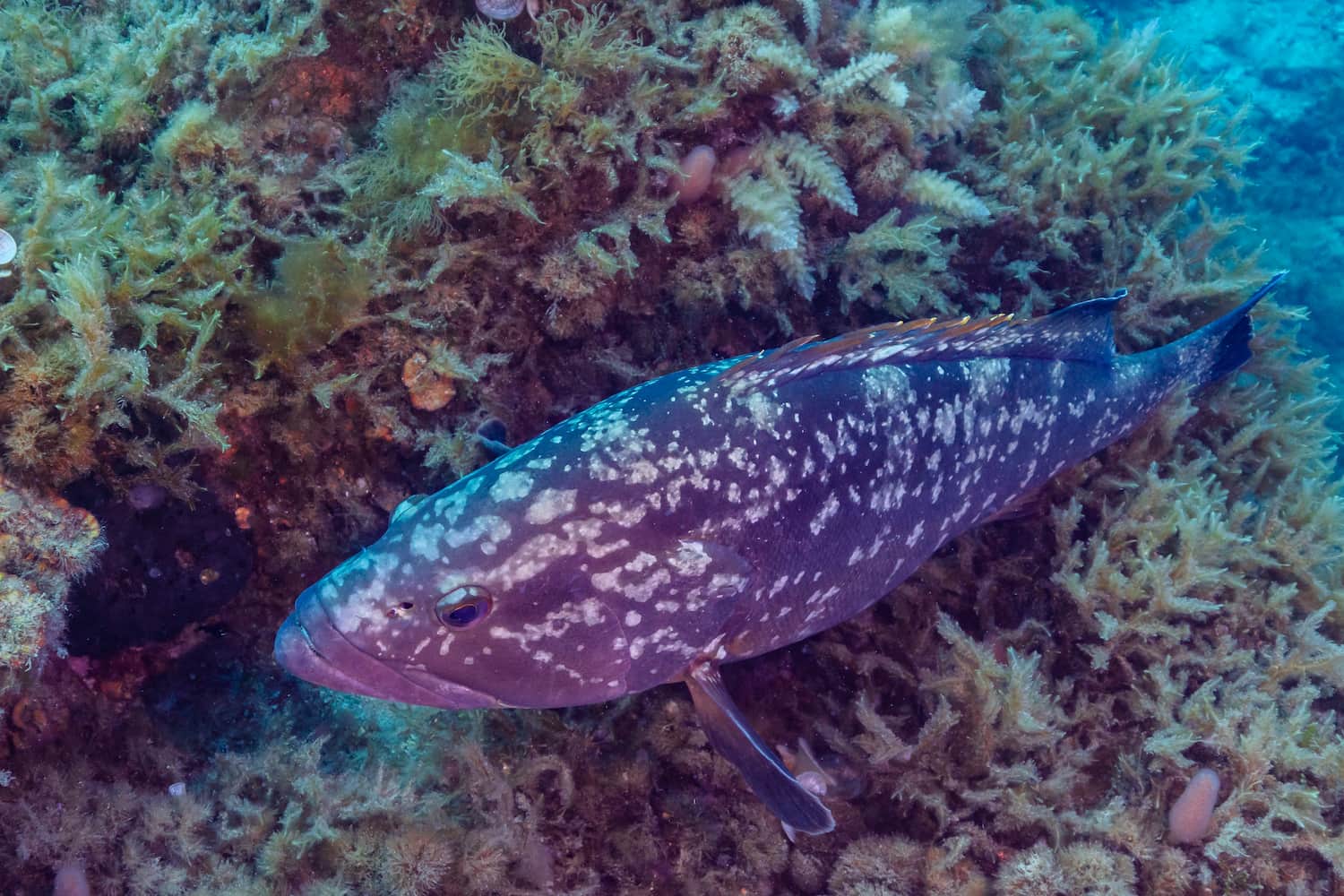
Photo: Diego Delso
How a virus crosses an ocean
No grouper swims from Indonesia to the Azores. The species is sedentary and territorial, with larvae of limited dispersal. The virus had to travel another way, and the betanodavirus literature offers three well-documented candidates2:
-
Globalised aquaculture. The RGNNV genotype is endemic in marine farms across Southeast Asia and the western Pacific, where it infects grouper, Asian sea bass and other high-value species. The international movement of broodstock (adult fish kept for breeding), eggs, larvae and live juveniles (legal and documented) is the best-established route of pathogen dispersal in modern aquaculture2. A batch of apparently healthy fry can carry the virus subclinically (without showing symptoms) and seed it in a facility thousands of kilometres away.
-
Maritime transport. Ballast water (water taken on by ships to maintain stability) and seawater cooling systems move billions of litres of coastal water between ports every year. There is no need to prove that a specific ship carried the virus to Ponta Delgada; it is enough to accept that shipping routes draw the same network of connections that phylogenetic trees draw.
-
Migratory or introduced host fish. Some pelagic species (fish that live in the open water column, not near the bottom) may act as asymptomatic vectors over long distances, although this route is considered less likely for RGNNV than the previous two2.
The Luís et al. study points to no specific ship or farm; phylogenetics identifies kinship, not culprits. But the spatiotemporal pattern is unambiguous: the Azorean strain descends from Indo-Pacific lineages, and its arrival is recent, consistent with the intensification of aquaculture and maritime trade over recent decades3.
The island trap
Island populations of long-lived, sedentary species tend to accumulate low genetic diversity. Isolation restricts gene flow, historical bottlenecks narrow the repertoire further, and the result is a population where nearly every individual shares the same immune-system variants. Under normal conditions that is no tragedy: local pathogens and hosts have spent generations negotiating a truce.
The problem arrives with a new pathogen. If no individual in the population carries the immune variants that could resist the foreign virus, the epidemic meets no friction. It infects, kills, moves on. It is the same principle that explains why smallpox devastated the Americas in the sixteenth century and why chytrid fungus (a fungal pathogen that causes mass die-offs in amphibians) erases frogs from entire mountain ranges: the issue is not the pathogen’s virulence, it is the host’s naivety.
The Azorean dusky grouper meets every condition of the trap: a long-lived species (it can exceed 50 years), late reproduction, predictable spawning aggregations that ease transmission, an isolated mid-Atlantic population and a pre-existing Endangered status. An outbreak that would be a bad year for a fast-breeding species can erase an entire generation of breeders here.
Responsibility, not fatality
The virus did not reach the Azores on ocean currents or by evolutionary chance: it arrived through the network of connections that humans have built between seas that geography kept apart. Every farm that imports broodstock without effective quarantine, every ship that exchanges ballast water, every batch of juveniles that crosses a paper-only sanitary border is a potential bridge for the next RGNNV.
The technical response exists and has been described for years2: real quarantines with molecular diagnostics, pathogen-free certification for live-animal movements, vaccination in aquaculture (commercial NNV vaccines already exist for several farmed species), routine genomic surveillance in sentinel wild populations, and ballast-water treatment standards that include fish viruses, not only bacteria and phytoplankton.
What is missing is treating marine biosecurity with the same seriousness we learned to apply to human biosecurity after 2020. The tools are the same (sequencing, surveillance, phylogenetic tracing) and the Azores study proves they work. The difference is that for fish we still lack the will to fund them before the outbreak, instead of counting bodies afterwards.
The Azores, fortunately, have something many places do not: a scientific community that watches, divers who report, and now a published genomic sequence that turns the 2024 outbreak into a global reference. That will not bring 148 groupers back. But it turns their death into information, which is the least we owe them.
A question for the reader
If your country imports live fish (for aquaculture, for the aquarium trade, for restocking), do you know what sanitary controls those movements require, and who checks that they are enforced?
Sources
Footnotes
-
Gomes, M., et al. (2025). “First detection of nervous necrosis virus in wild dusky grouper from the Azores.” DOI pending confirmation. ↩ ↩2
-
Bandín, I., & Souto, S. (2020). “Viral encephalopathy and retinopathy: an update.” Reviews in Aquaculture. DOI: 10.1111/raq.12448 ↩ ↩2 ↩3 ↩4 ↩5
-
Luís, A., et al. (2026). “Unraveling the origin of the Azorean viral nervous necrosis 2024 outbreak through spatiotemporal and time-resolved phylogenetic analysis.” Frontiers in Marine Science. DOI: 10.3389/fmars.2026.1848526 ↩ ↩2 ↩3
Topics
Newsletter
A weekly reading to see the aquatic world with clearer judgment.
Receive short, carefully edited reflections on aquatic life, ethical aquarium keeping, and applied science.
Subscribe