

The Twilight Garden: Living Corals at 54 Meters Off Benin
Sixty years after 1963 soundings wrote off the reefs of Benin's continental shelf, an expedition using sidescan sonar and underwater drones finds a living mesophotic garden at 54 meters: the first visual evidence of live coral in the continental Gulf of Guinea.
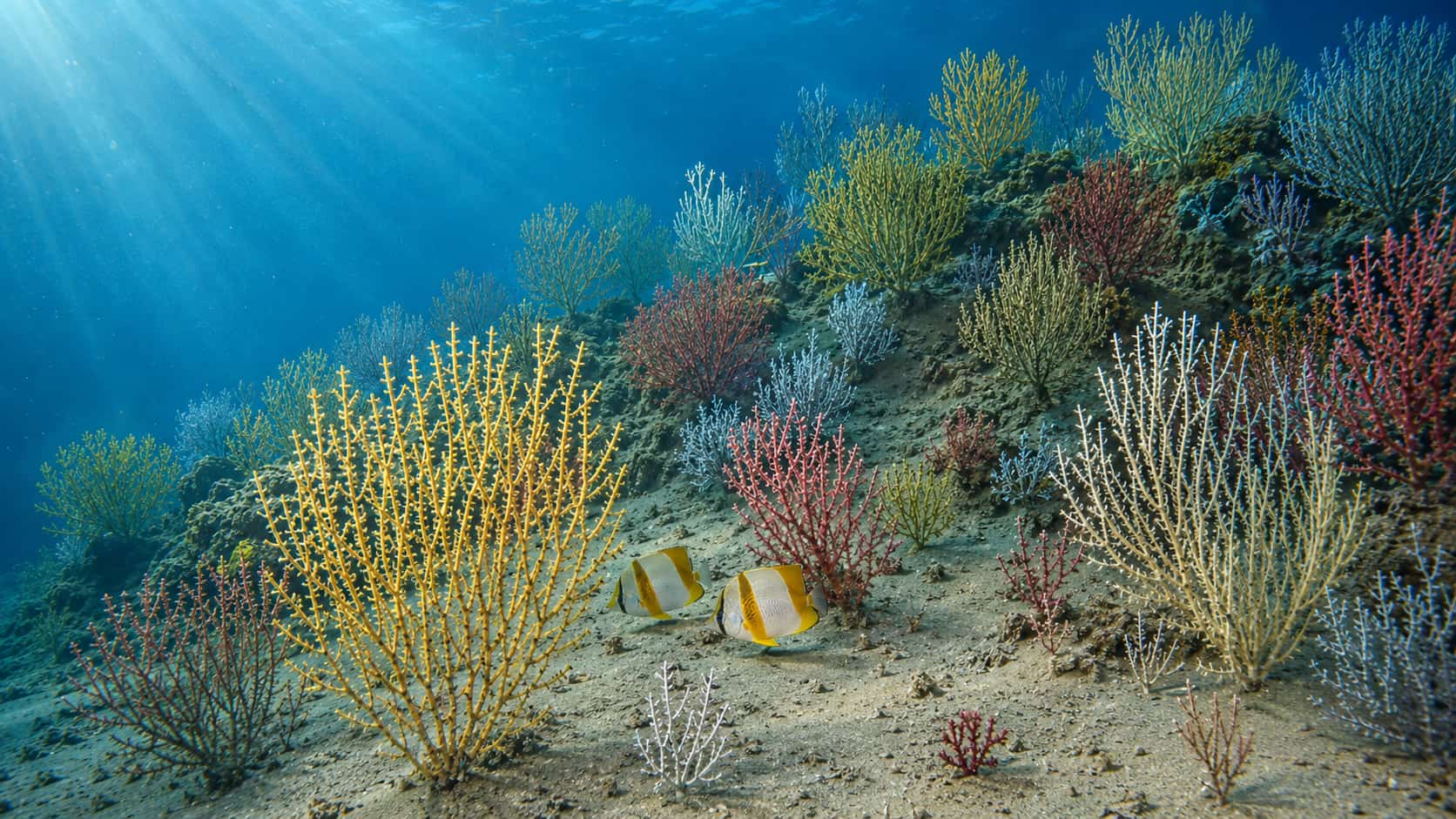
Photo: AI generated
At 54 meters depth, off the coast of Benin, sunlight is only 1% of surface levels. This is enough for some photosynthetic organisms, but insufficient for the reef-building corals typical of shallow waters. The water holds a gray-blue twilight in which shapes are recognized by silhouette before color. Over rocky blocks, sea fans (colonial octocorals that form flat, fan-shaped structures) open against the current. Dark branches of black corals (antipatharians, a group of corals with dark, spiny skeletons) curve upward. Among them, fish move: snappers patrolling slowly, damselfish flickering in small, nervous schools.
No one had seen this here before.
For more than half a century, the maps of Benin’s continental shelf told a story of absence. Soundings from 1963 had described a sedimented seafloor with no reef structure worth naming, and that verdict was repeated from publication to publication until it hardened into consensus. For coral science, the continental Gulf of Guinea was blank territory.1
Sixty Years of Silence
This discovery begins with a correction. A team led by Zinzindohoué and colleagues decided to look again at Benin’s shelf with tools that did not exist in 1963: sidescan sonar to map the relief of the seafloor, and underwater drones (remotely operated vehicles, or ROVs) to descend to whatever structures the sonar drew.1
The sonar showed something unexpected: rocky blocks rising from the sediment, with a geometry that did not match simple eroded relief. The drones went down to check. What their cameras recorded was published in July 2026 in Frontiers in Marine Science: a living mesophotic garden of octocorals (soft corals with eight-branched polyps), gorgonians (sea fans with a flexible, horny skeleton), and black corals, with at least eight species of reef fish moving among the branches.1
It is the first visual evidence of live coral in the continental Gulf of Guinea. For sixty years, science assumed dead an ecosystem that was there all along, half an hour from shore, growing in the dim light.
The Zone Where Light Gives Up
Mesophotic reefs occupy the ocean’s middle band, roughly between 30 and 150 meters deep, where light is enough to sustain photosynthetic life but too scarce for the stony corals (Scleractinia) that build shallow-water reefs.2 The name comes from Greek: meso, middle; phos, light. It is the underwater twilight zone.
For decades, these ecosystems were invisible to science for a practical reason: they lie below the comfortable limit of recreational diving (typically 30-40 meters) and above the depths where research submersibles usually work. Only the spread of remotely operated vehicles and technical diving has begun to make them mappable.2
In the tropical western Atlantic, mesophotic reefs had already delivered surprises. In the insular Gulf of Guinea, Morais and Maia described in 2017 genuine underwater forests of mesophotic corals, lush communities that challenged the idea that the region was poor in coral structure.3 But those forests grew around oceanic islands. The continental shelf, loaded with sediment from the Niger and other great rivers, was still considered sterile for coral.
The Benin garden breaks that mental border.1
A Garden of Fans and Black Corals
What the drones found is not a stony coral reef like those of the Caribbean or the Indo-Pacific. It is something different and, in a way, more delicate: a community dominated by octocorals and gorgonians, with black corals (antipatharians) rising among the blocks.1
Octocorals take their name from the eight-branched polyps with which they filter the water. Each polyp is a tiny animal with eight tentacles that captures plankton from the passing current. Many octocorals form flat fans oriented perpendicular to the current, like sails trimmed to the prevailing wind, to maximize their catch. Gorgonians add three-dimensional structure: branching limbs that create shelter for fish and invertebrates. Black corals, with dark skeletons and extremely slow growth (sometimes only a few micrometers per year), can live for centuries; each colony is an archive of the chemical history of the water around it.1
Together they form what ecologists call an animal forest: a forest built not by plants but by colonial animals, where the very architecture of the landscape is alive.3 In the mesophotic dimness, these gardens work as oases of structural complexity on a seafloor otherwise dominated by soft sediments.
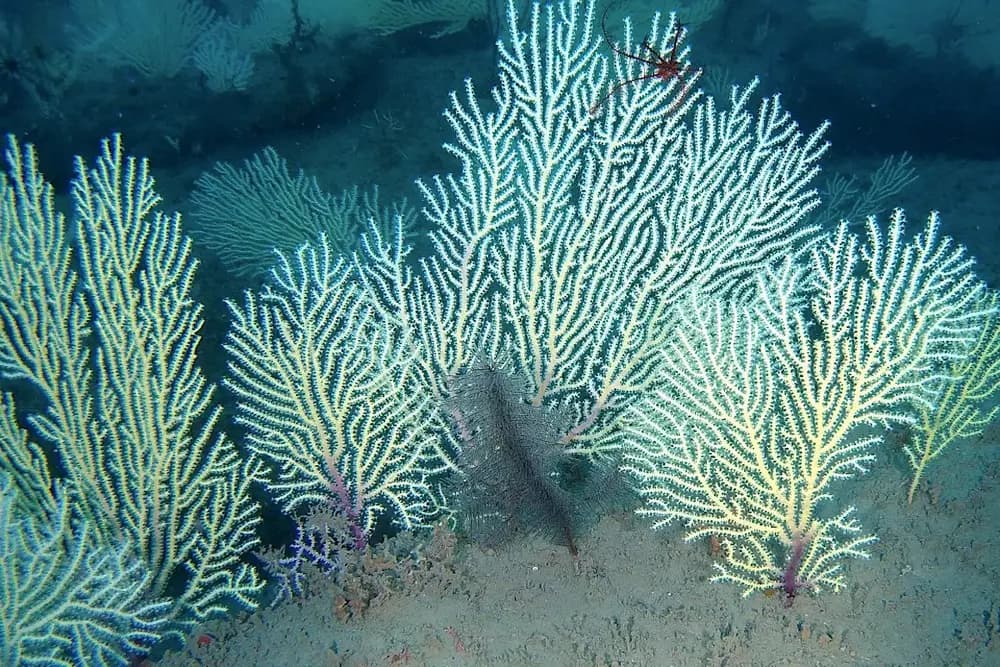
Photo: Gérard Zinzindohoué
Eight Species Among the Branches
A garden without inhabitants would be mere geology with ambitions. Benin’s has fish: the team documented eight reef fish species associated with the structure, including snappers (Lutjanidae) and damselfish (Pomacentridae) moving among the fans.1
The detail matters. Reef fish do not appear by chance: they need shelter, prey, and nursery grounds. Their presence indicates that the garden is not an isolated accident of a few hardy colonies but a functioning ecosystem, with its own food web and dynamics.1 That eight reef fish species were recorded on a first survey suggests, moreover, that the real inventory is larger. Mesophotic studies elsewhere always show the same pattern: every dive adds new species to the list.2
The Map That Needs Redrawing
For sixty years, maps of Benin’s shelf copied one another with the same conclusion: nothing to see here. Absence of evidence quietly became evidence of absence.1
Breaking that cycle takes little: better sonar, a drone, the decision to go down and look. But it takes all three at once, and for six decades no one brought them together off Benin. The finding invites a question: how many other continental shelves, in West Africa and beyond, hold similar gardens under the label “sedimentary seafloor”?1
Tropical Atlantic octocorals and black corals include threatened species, vulnerable to physical disturbance of the seafloor.4 A trawl net passing over a mesophotic garden does not damage it: it dismantles it. And unlike a shallow reef, whose condition can be tracked from the surface, a garden at 54 meters can be destroyed without anyone ever knowing it existed.2
Benin’s garden was lucky: it was found before it was erased. That sequence (discover first, protect after) is the only one that guarantees the twilight keeps its fans.
What Grows Where No One Looks
At the end of every dive, the drones ascend and the light changes: from blue-gray to turquoise, from turquoise to a surface broken by sun. The garden stays below, in its stable dusk, indifferent to being discovered. The fans remain oriented to the current. The damselfish keep flickering among the branches. The black corals keep adding microscopic rings to their dark skeletons.
They had been there at least as long as it took us to look again.
A Question for the Reader
If an entire ecosystem could stay invisible for sixty years half an hour from the coast, how many more worlds are waiting beneath the parts of the map we think we already know?
Sources
Methodological note: the garden’s characteristics (54 m depth, coral groups present, number of fish species, instrumentation used, and the 1963 soundings background) come from the primary study by Zinzindohoué et al. (2026). The general description of the mesophotic zone and its depth limits relies on the synthesis by Pyle & Copus (2019). The term “animal forest” and the insular regional context come from Morais & Maia (2017). No figures, species, or dates beyond those in the cited sources have been added.
Footnotes
-
Zinzindohoué et al., “First evidence of live mesophotic coral reefs on the Benin continental shelf”, Frontiers in Marine Science, Discoveries (2026). DOI: 10.3389/fmars.2026.1848226. [Primary; high reliability] ↩ ↩2 ↩3 ↩4 ↩5 ↩6 ↩7 ↩8 ↩9 ↩10
-
Pyle & Copus, “Mesophotic Coral Ecosystems: Introduction and Overview”, in Mesophotic Coral Ecosystems, Springer (2019). DOI: 10.1007/978-3-319-92735-0_1. [Primary; high] ↩ ↩2 ↩3 ↩4
-
Morais & Maia, “Lush underwater forests in mesophotic reefs of the Gulf of Guinea”, Coral Reefs (2017). DOI: 10.1007/s00338-016-1523-z. [Primary; high] ↩ ↩2
-
IUCN Red List of Threatened Species, assessments of tropical Atlantic octocorals and antipatharians (https://www.iucnredlist.org), consulted 2026-07-20. [Database; high] ↩
Topics
Newsletter
A weekly reading to see the aquatic world with clearer judgment.
Receive short, carefully edited reflections on aquatic life, ethical aquarium keeping, and applied science.
Subscribe