

The forest that eats the river: the Amazonian igapó, where fish plant the trees
For six months each year, the Amazonian igapó becomes a submerged forest where pacu and catfish swallow fruits and scatter seeds between the trunks, merging jungle and river into a single blackwater organism.
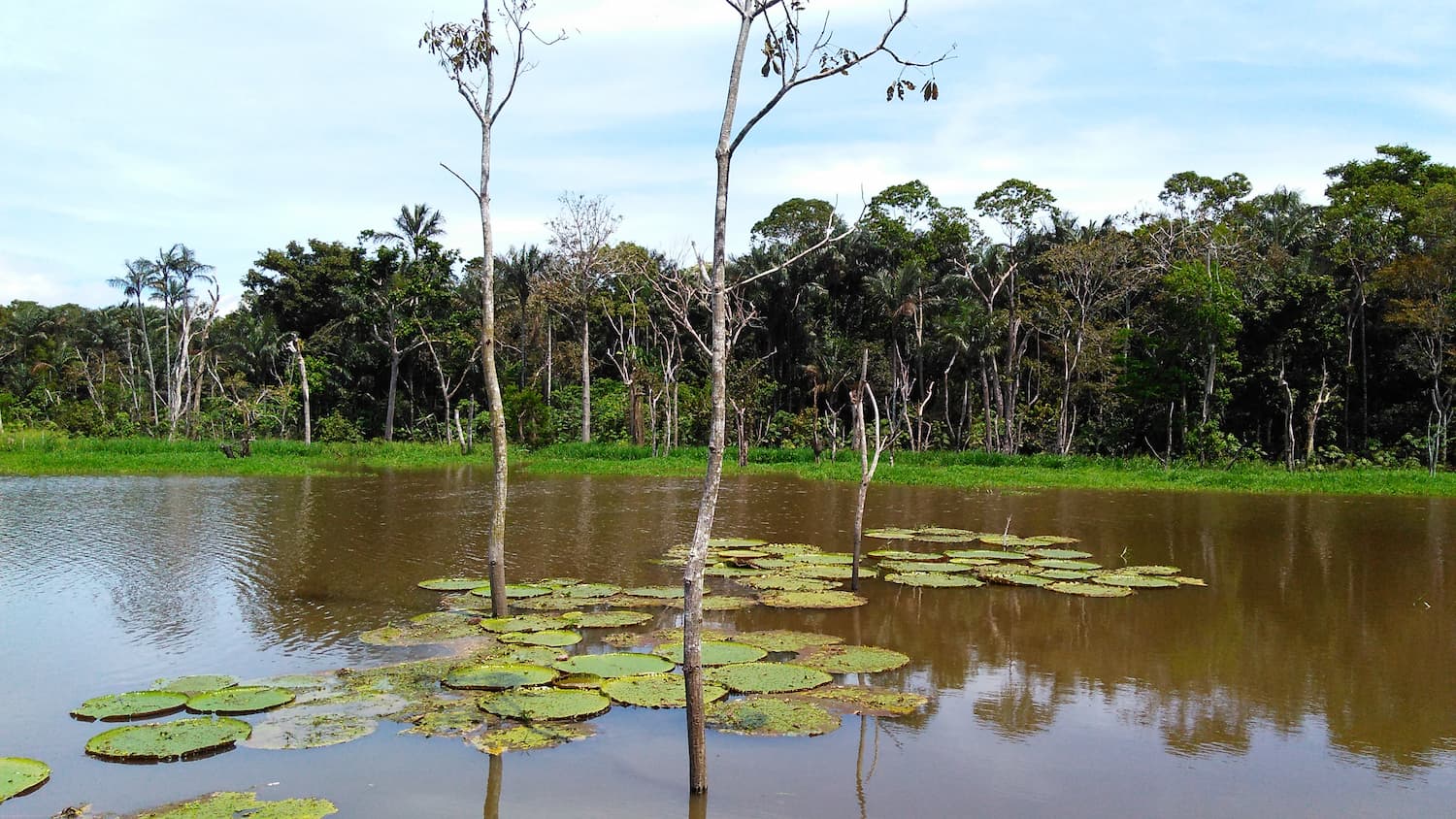
Photo: José Renato Venâncio Resende
At dusk, at the height of the flood, the Rio Negro stops looking like a river. The water has risen ten meters since the dry season and has entered the forest. The trees are still there, vertical, trunks submerged halfway up, crowns barely above the surface. A pacu (Colossoma macropomum, a large frugivorous fish with molar-like teeth) moves slowly between two roots, turns on itself, and stops beneath a branch heavy with fruit. When one falls, it swallows it whole. It has just planted a tree.
For several months each year, the Amazon rainforest does not end where the river begins. The two ecosystems fuse into one, a blackwater forest where fish take over from birds and mammals as the gardeners of the canopy.
A forest underwater
The word igapó refers to the floodplain forests of blackwater river basins, chiefly the Rio Negro and its tributaries. Unlike the várzea, which receives white sediments and nutrients from the Andes, the igapó floods with acidic, dark, mineral-poor water, stained by tannins and humic acids (organic compounds released as leaf litter decomposes on sandy soils).1 The result is a tea-colored water column that barely lets light through, where visibility can drop to a couple of meters.
Rio Negro water levels rise and fall by several meters each year following the pulse of the rains, and igapó trees have evolved with that pulse for millions of years. Some spend six or seven months with their trunks underwater; others keep adventitious roots (roots that grow from stems or trunks, not from the main root system) ready to breathe once the soil drowns.1
Trees built to drown without dying
Recent functional characterizations of Amazonian flora show that flooded forests harbor a set of species with traits quite distinct from those of terra firme forest (dry, non-flooded forest): less dense wood, bark that tolerates months of immersion, seeds adapted to float or to be eaten by fish.2 In the igapó, life does not merely endure the flood. It has turned the flood into its strategy.
Many igapó trees time their fruiting to the moment when the water reaches its peak. While the forest lies submerged, the fruits ripen and drop onto the surface. Instead of hiding their seeds from the water, they hand them over to the river. Reproductive success depends on someone picking them up underwater.1
The silent gardeners
The frugivorous fishes (fruit-eating fishes) of the Amazon, including species such as the pacu and several large catfish (Siluriformes), patrol the flooded forest during high water. Some wait directly beneath producing trees; others orient towards the sound of fruits striking the water, a cue that guides several species to submerged food sources.1
The pacu is the best-documented case. With molar-like teeth able to crush hard seeds, yet with a digestive tract that leaves many of them intact, it can swallow whole fruits, swim for kilometers through the drowned forest and deposit the seeds far from the parent tree, in places where seedlings will find light once the waters recede.13 Bottom-dwelling catfish play a complementary role: they gather fallen fruits and move them along the substrate, redistributing the sowing across gradients no bird could reach.3
The most recent review of Amazonian biodiversity stresses that this river-forest connectivity is not marginal. Flooded forests are one of the main engines of fish and plant diversification across the basin, and their functioning depends on animals still being able to move seasonally between them.4
Black water, green light
To dive into an igapó at high water is to enter a forest of dark green. The light that manages to cross the canopy and the tannin-loaded water turns oblique, filtered, almost subterranean. Schools of frugivorous fish move between trunks like flocks of birds, and in the gloom appear young arawana (Osteoglossum bicirrhosum, a large surface-feeding fish), freshwater stingrays (Potamotrygonidae) buried in the leaf litter, and sometimes botos (the pink river dolphins, Inia geoffrensis) that have learned to navigate a labyrinth that changes every year.
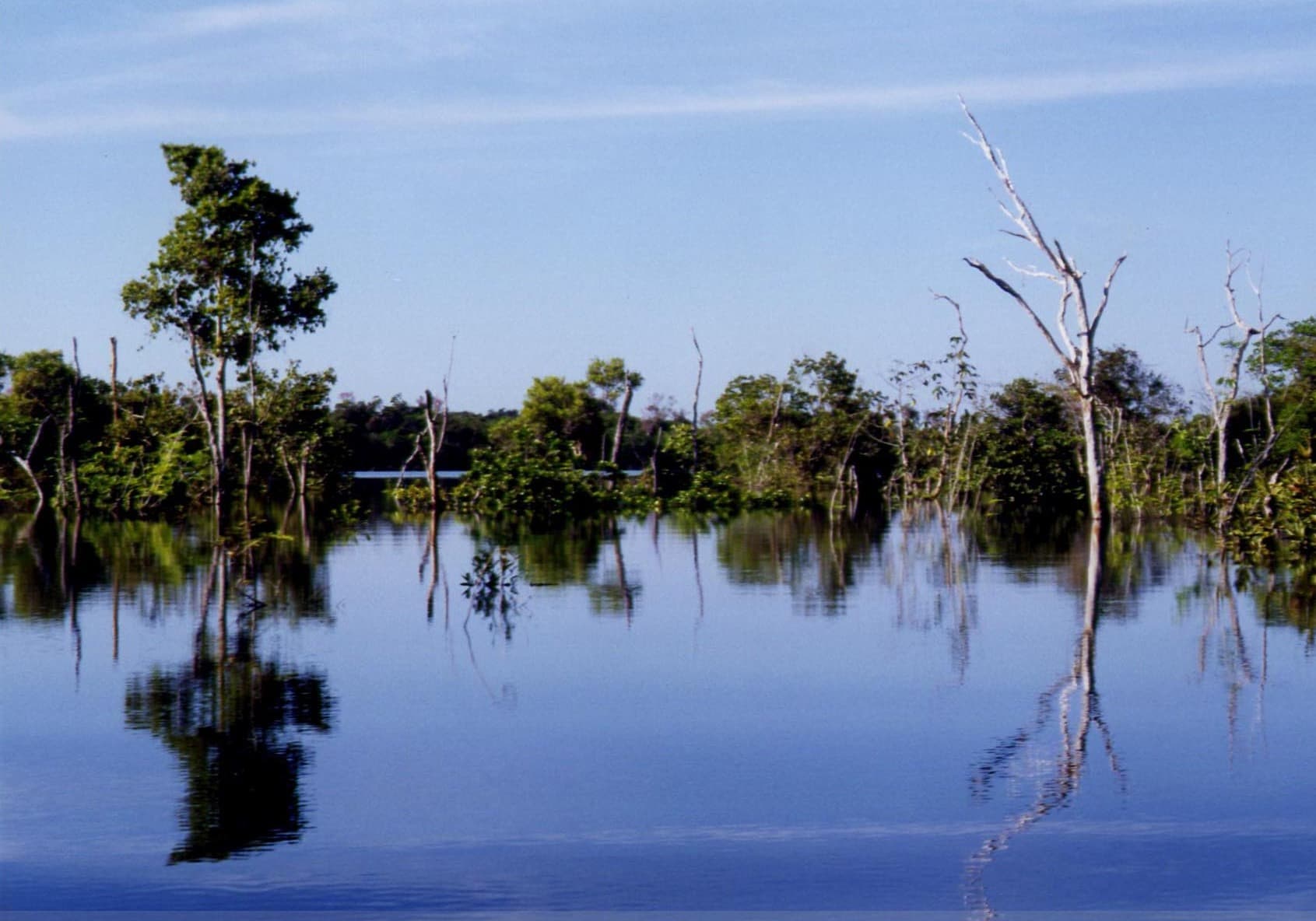
Photo: José Renato Venâncio Resende
Fish inventories across the basin document exceptional diversity in these habitats, with communities adapted to low oxygen, acidic water and the seasonal availability of fruit.3 The biological productivity of the igapó is lower than that of the várzea, because black waters deliver fewer nutrients, but that chemical poverty has favored extraordinary specializations: air-breathing fish, fish with slowed metabolisms, fish that live almost entirely on what the forest lets fall.
What breaks when the forest is cut
The relationship between igapó fish and trees is so tight that it works both ways. The trees need the fish to disperse their seeds. The fish need the trees to eat. Riparian deforestation, dams that cut off migration and the overfishing of frugivorous species all break that circuit.43
When the pacu disappears from a stretch of river, the trees keep fruiting, but their seeds fall into the water and rot near the trunk. Without dispersers, the forest loses its capacity to regenerate. When the riverside trees disappear, frugivorous fish lose the food source that lets them survive the flood. The igapó is not a forest that suffers flooding; it is a forest that demands it. And it demands it with fish inside.
And in the aquarium, what then?
An igapó biotope (a tank designed to replicate a specific natural habitat) does not need to be huge. It needs to be honest. Soft, acidic, dark water; mangrove roots or submerged wood forming a three-dimensional structure; leaf litter releasing tannins; subdued lighting; and above all, fish whose behavior makes sense in that setting. An Amazonian frugivorous fish in a bare tank is not a fish in captivity, it is a gardener without a garden.
The lesson of the igapó for the aquarist is the same as for the ecologist: you cannot conserve a species without conserving the relationship that sustains it. In a tank, that means treating water chemistry and refuge architecture as part of the animal, not as added decoration.
A question for the reader
If an entire forest depends on a fish swallowing a seed and depositing it far from the tree that produced it, where does the tree end and the fish begin?
Sources
Methodological note: descriptions of frugivorous behaviour in pacu and catfish, and of igapó flooding times, are based on the synthesis available in Wikipedia and in Junk et al. (2007). Statements about river-forest connectivity and diversification follow Ribas et al. (2025). Functional-trait characterisations of flooded-forest trees rely on ter Steege et al. (2025). Where no agreed figure exists (e.g., exact flood duration per species), a descriptive range has been used to avoid false precision.
Footnotes
-
Wikipedia, “Igapó”, consulted 6 July 2026. https://en.wikipedia.org/wiki/Igap%C3%B3 [Secondary; medium reliability; used for general ecosystem description, water chemistry and dispersal mechanisms] ↩ ↩2 ↩3 ↩4 ↩5
-
ter Steege, H. et al., “Functional characterization of Amazonian tree flora”, Communications Biology (2025). https://www.nature.com/articles/s42003-025-07961-6 [Primary; high reliability] ↩
-
Junk, W. J. et al., “Freshwater fishes of the Amazon River basin: their biodiversity, fisheries, and habitats”, Aquatic Ecosystem Health & Management 10 (2007). DOI: 10.1080/14634980701351023 [Primary; high reliability] ↩ ↩2 ↩3 ↩4
-
Ribas, C. C. et al., “Rivers and the origin and future of Amazonian biodiversity”, Nature Reviews Biodiversity (2025). https://www.nature.com/articles/s44222-024-00040-6 [Primary; high reliability] ↩ ↩2
Topics
Newsletter
A weekly reading to see the aquatic world with clearer judgment.
Receive short, carefully edited reflections on aquatic life, ethical aquarium keeping, and applied science.
Subscribe