

The Floating Golden Forest: The Great Atlantic Sargassum Belt
Since 2011, a floating forest of sargassum weighing millions of tonnes has crossed the tropical Atlantic each year. Beneath its golden canopy shelter turtle hatchlings, camouflaged fish, and hundreds of invertebrates: a nomad ecosystem that can only be measured from space.
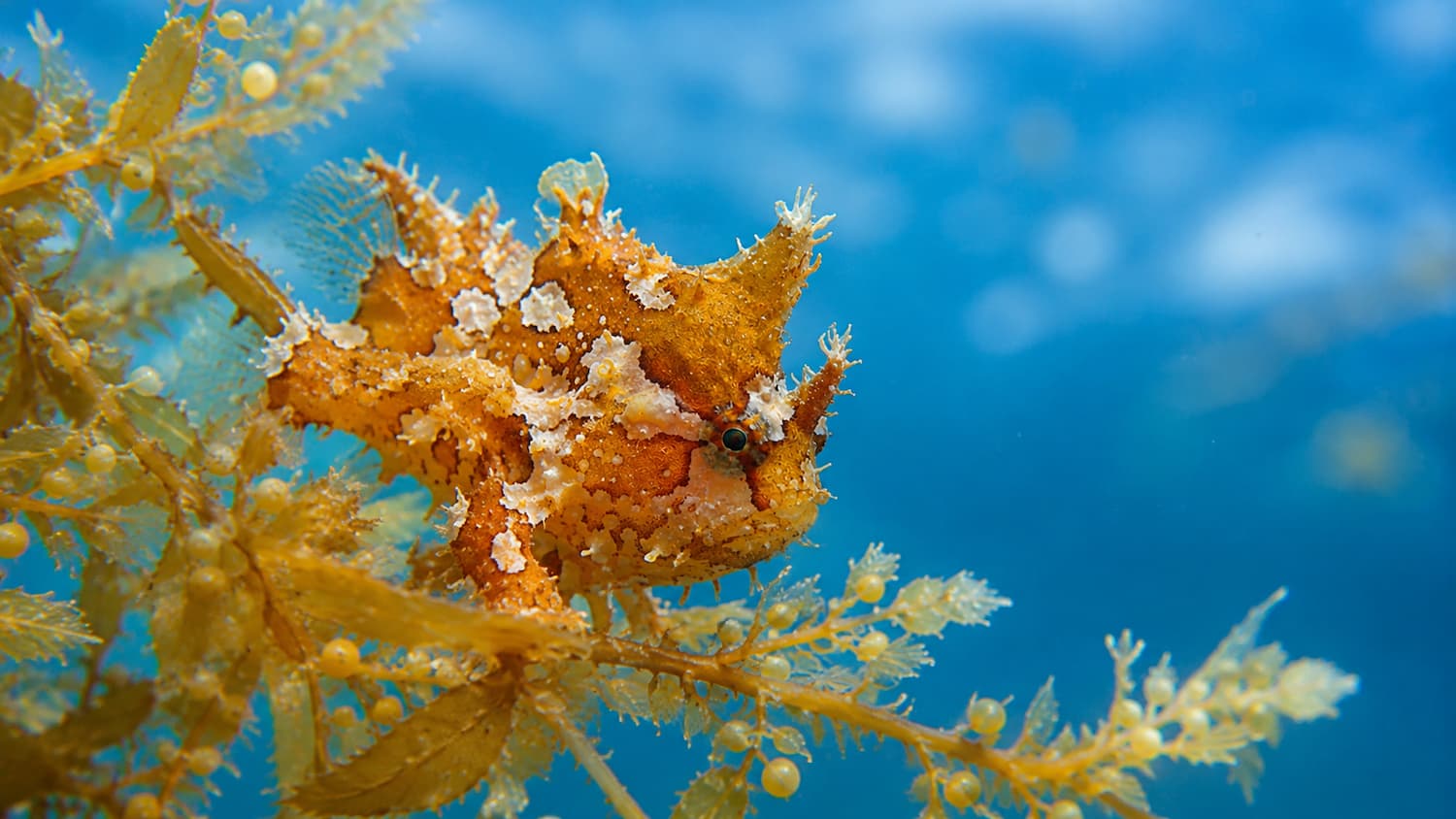
Photo: AI generated
Seen from below, sargassum becomes a ceiling. Brown fronds (leaf-like structures) interlace at the surface and filter the midday light into green and golden columns. Gas-filled floats (pneumatocysts, small spherical bladders that keep the alga buoyant) shine like amber beads against the blue. In the shade of the canopy, a sea turtle hatchling the size of a cookie rests with folded flippers. A hand’s width away, motionless, a sargassum fish (Histrio histrio) mimics the frond that shelters it and waits, its lure ready, for a curious fish to come too close.
This forest drifts across the tropical Atlantic. In some years it stretches from coast to coast, from the Sargasso Sea to the Gulf of Guinea, gathering millions of tonnes of living algae. It is the largest macroalgal bloom (a rapid increase in the population of large algae) in the global ocean, and only from space can it be measured whole.12
An alga that never touches the seafloor
Sargassum is a brown macroalga whose fronds carry small gas-filled vesicles (pneumatocysts). These floats hold the plant near the surface, where the light reaches for photosynthesis.3
In the open ocean, pelagic sargassum (sargassum that lives in the open water column, not attached to the bottom) spends its entire life adrift. It multiplies by fragmentation: each piece of frond can grow and give rise to a new patch, without anchoring to any substrate. Nothing in its cycle requires touching the seafloor.3
The Sargasso Sea, north of the Caribbean, was for centuries its known home: a region of calm waters where sailors reported fields of seaweed stretching to the horizon. But since 2011 something new has been happening. Almost every year, enormous quantities of sargassum appear in the tropical Atlantic, far from that legendary sea, and form a belt scientists had never seen before in satellite imagery.2
The belt seen from space
In 2019, a team led by Mengqiu Wang published the map of that belt in Science. Analysing nearly two decades of satellite data, the researchers described the Great Atlantic Sargassum Belt: a band of floating algae that in 2018 stretched some 8,850 kilometers, from the Gulf of Guinea to the Gulf of Mexico, and that year exceeded 20 million tonnes of biomass.2
Six years later, a global analysis confirmed the scale of the phenomenon. Rong Qi’s team reviewed 1.2 million satellite images taken between 2003 and 2022 and concluded that floating macroalgal blooms are expanding across the planet. Among them, the Atlantic sargassum bloom is the largest of all, and its extent has doubled in a decade.1
The belt shifts with the seasons. It grows in one hemisphere, decays, reappears the following year with a different shape and a different weight. No coastline contains it; no border defines it. It is a nomad ecosystem whose map exists only in the orbits of the satellites that watch over it.2
The inhabitants of the canopy
For marine life, a patch of sargassum is far more than a floating plant. It is refuge, pantry, and nursery. Crabs and shrimp hide beneath the canopy, juvenile porcupinefish and seahorses take shelter there, and hundreds of invertebrates (animals without a backbone, such as crustaceans, mollusks, and worms) teem on the fronds or among them.3
Sea turtles find here an irreplaceable nursery. After hatching on the beach and reaching the water, the hatchlings swim out to the open ocean and seek the sargassum. Among the fronds they find food and protection from predators during their first years, the most fragile of their lives.3
The fish that became seaweed
No inhabitant of the canopy takes mimicry as far as the sargassum fish. Histrio histrio is a frogfish (a type of anglerfish with a modified dorsal spine used as a fishing lure) whose body imitates the alga in shape and color: its fins look like fronds, its skin reproduces the brown and golden tones of sargassum, and its dermal appendages (small skin outgrowths) complete the disguise. Motionless among the vegetation, it becomes almost indistinguishable from its surroundings, and it can change color to match its backdrop.4
From that hiding place it hunts. Like other frogfishes, it carries on its head a modified dorsal spine that works as a rod and lure (the illicium). When a prey swims closer to inspect the appendage, the fish opens its enormous mouth and swallows it in an instant, even when the victim approaches its own size.4
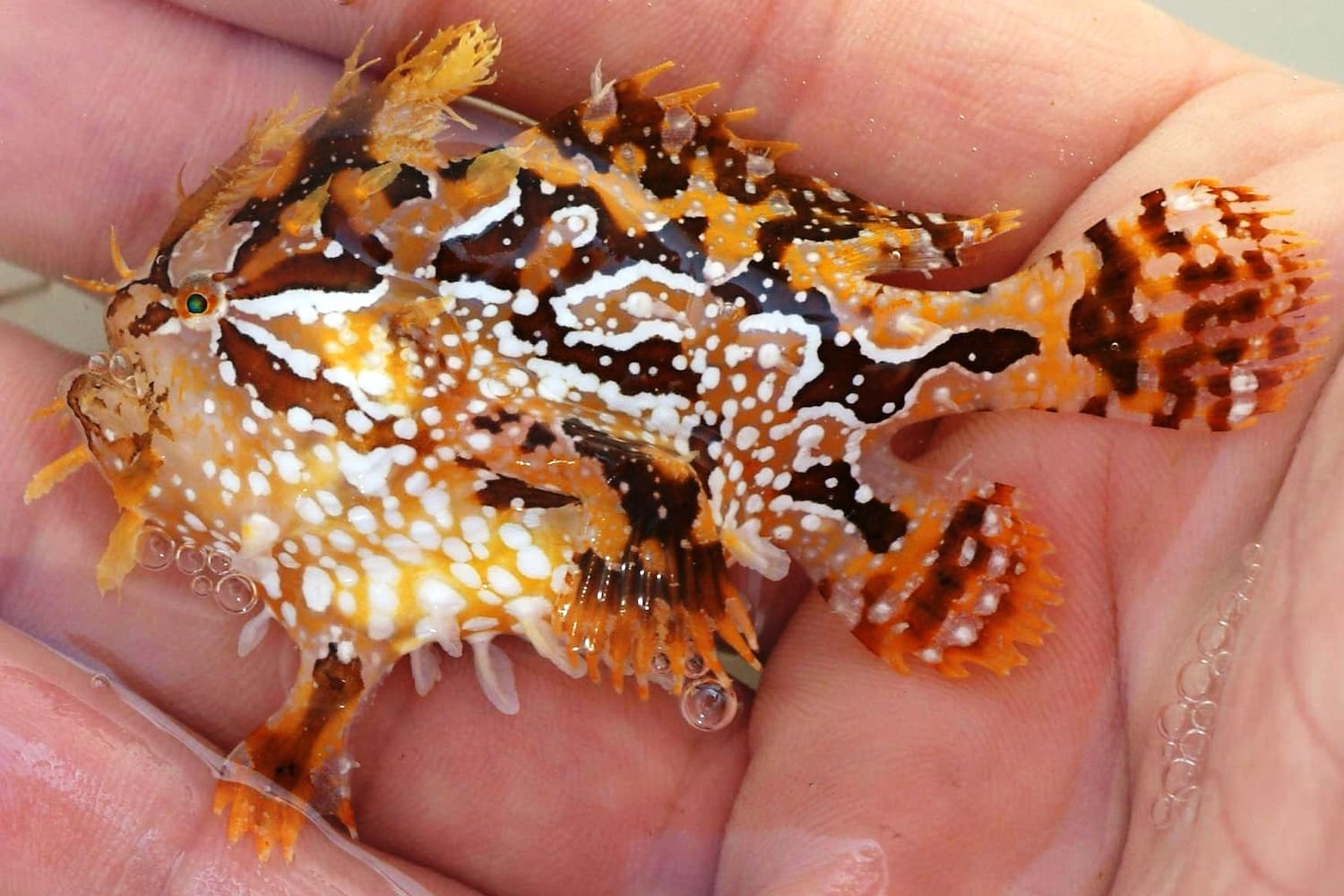
Photo: SEFSC Pascagoula Laboratory; Collection of Brandi Noble, NOAA/NMFS/SEFSC
When the forest reaches land
The same belt that shelters life in the open ocean changes sign when it reaches the coast. Satellite studies documented massive sargassum strandings on Caribbean and West African beaches in the years of the largest blooms, with mountains of algae piling up on the sand where turtles once nested.2 The floating forest remains a sanctuary offshore; the problem begins when wind and current throw it against the shore.
The drifting forest
At dusk, the light crosses the canopy at a low angle and the sargassum glows in a dense gold. The turtle hatchling stays quiet among the fronds. The sargassum fish has changed position without anyone seeing it move. Below, in the blue half-light, a school of small silver fish turns in unison and takes cover again beneath the algal roof.
Nobody planted this forest. Nobody waters it or prunes it. It grows in the middle of the ocean, travels with the currents, shelters whoever arrives, and dissolves each year to form again. That is why it remained invisible for so long: until a satellite looked at it head-on, the Atlantic’s largest forest was just another drifter.
A question for the reader
If the ocean’s largest forest floats, moves, and belongs to no country, how do we protect something that has no borders?
Sources
Methodological note: the extent and biomass figures refer to 2018 according to Wang et al.; the doubling of extent over a decade comes from the 2003-2022 satellite record analysed by Qi et al. The list of associated fauna follows the NOAA fact sheet; the details of Histrio histrio camouflage and hunting come from the secondary source cited.
Footnotes
-
Qi et al., “Global floating algae blooms are expanding”, Nature Communications (2025). Analysis of 1.2 million satellite images from 2003-2022; the Atlantic Sargassum bloom is the largest macroalgal bloom in the global ocean. https://www.nature.com/articles/s41467-025-66822-5 [Primary; high reliability] ↩ ↩2
-
Wang et al., “The great Atlantic Sargassum belt”, Science (2019). Satellite description of the Great Belt: up to about 8,850 km in extent and more than 20 million tonnes in 2018; recurrent blooms since 2011 and strandings documented on Caribbean and West African coasts. https://www.science.org/doi/10.1126/science.aav7912 [Primary; high] ↩ ↩2 ↩3 ↩4 ↩5
-
NOAA Ocean Service, “Sargassum: A Floating Habitat”. Institutional fact sheet on sargassum as floating habitat: gas-filled floats, reproduction by fragmentation, associated fauna (fish, crabs, shrimp, juvenile turtles) and its role as refuge, food, and nursery. https://oceanservice.noaa.gov/facts/sargassum.html [Secondary; high] ↩ ↩2 ↩3 ↩4
-
Wikipedia, “Sargassum fish (Histrio histrio)”. Camouflaged frogfish that mimics algal fronds, changes colour, and ambushes prey with a lure. https://en.wikipedia.org/wiki/Sargassum_fish [Secondary; medium] ↩ ↩2
Topics
Newsletter
A weekly reading to see the aquatic world with clearer judgment.
Receive short, carefully edited reflections on aquatic life, ethical aquarium keeping, and applied science.
Subscribe