

The animals that stole the sun: sea slugs that photosynthesize
Certain sea slugs of the genus Elysia steal chloroplasts from the algae they eat and keep them working inside their own cells for months. It is the only known case in the animal kingdom of stable appropriation of photosynthetic machinery.
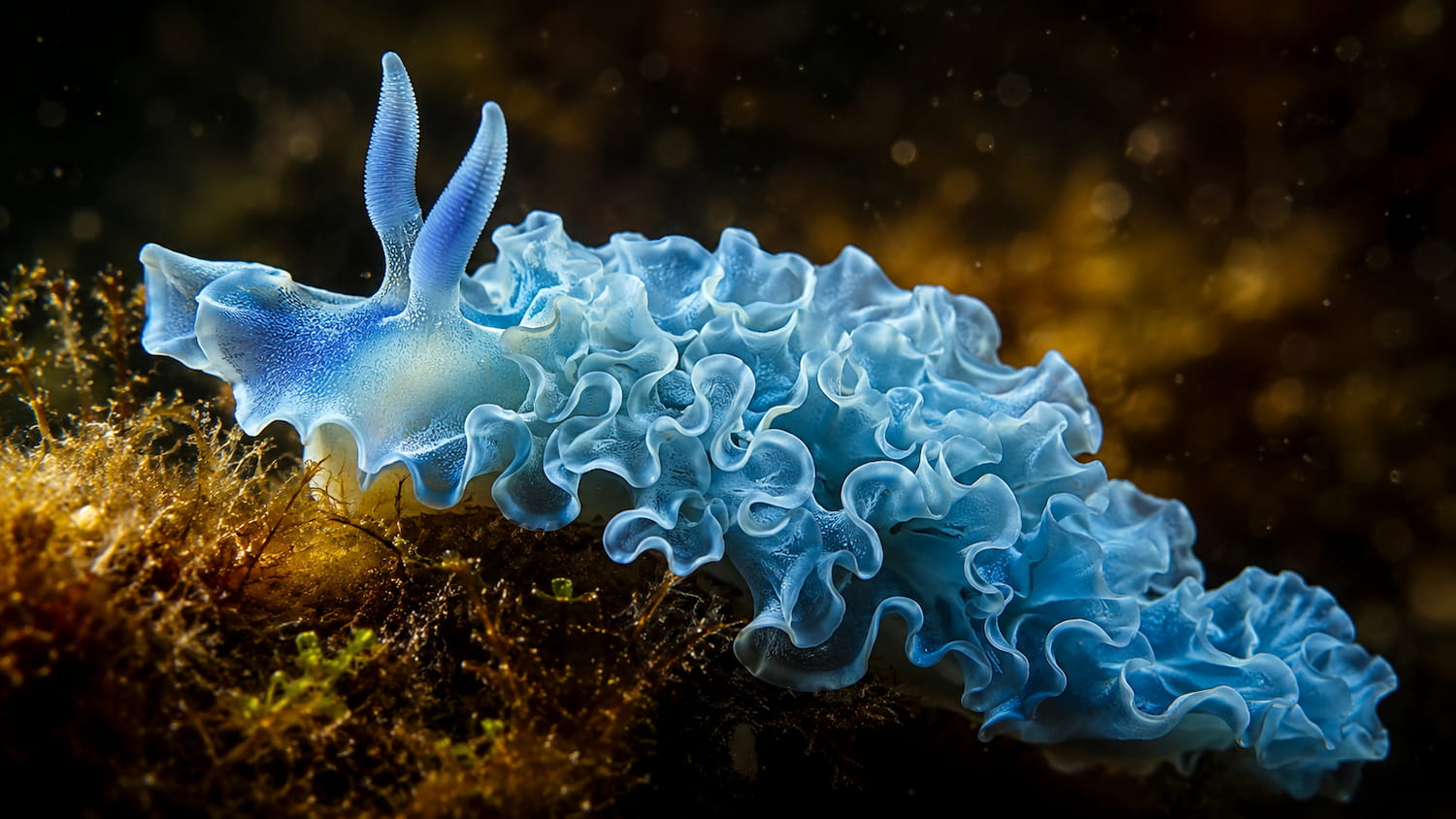
Photo: AI generated
Three meters down, on a macroalga (a large, multicellular alga visible to the naked eye) swaying with the tide, a slug the size of a fingernail inches forward. Its body is emerald green, with edges so thin they let the light through. As it grazes, it does more than feed: it stores part of the alga inside its own cells and puts it to work. For the next few months, that stolen piece will keep capturing photons and producing sugars for its new owner. The slug has become, in part, a photosynthetic organism.
The theft that lasts for months
The phenomenon has a name: kleptoplasty, from the Greek kleptes, thief. It means taking chloroplasts (the organelles within plant cells where photosynthesis occurs) out of algal cells and keeping them alive and functional inside one’s own body.1
The trick is not exclusive to these animals. Several unicellular organisms practice forms of kleptoplasty. But among animals, the sacoglossans, a group of sea slugs known as “sap-sucking slugs” for the way they feed, are the only known case of stable appropriation of photosynthetic machinery.1
Their technique is surgical. Instead of biting and shredding the whole alga, the sacoglossan punctures the cell wall with a specialized radula (a tongue-like organ with teeth, unique to mollusks) and sucks out the contents, the way you might pierce a blister and drink what is inside. Most of that content gets digested. The chloroplasts do not.1
The engineering of the heist
The stolen chloroplasts end up housed in the cells lining the digestive diverticula, a system of branching ducts that spreads through the slug’s flattened body. There, lit by the sunlight passing through the animal’s nearly transparent skin, they keep doing the one thing they know how to do: photosynthesis.2
The scientific puzzle is how this is possible. A chloroplast is not a self-sufficient part: inside the alga, it depends on proteins built under instructions from the plant nucleus. When the slug keeps the chloroplast, it leaves the nucleus behind. Without that spare-parts factory, the organelle should degrade within days. In several Elysia species, the sequestered chloroplasts remain photosynthetically active for months.21
A lipidomics study (the large-scale study of lipids, or fats, in biological systems) published in 2026 in Frontiers in Marine Science adds a piece to the puzzle. Analyzing the membranes of the kleptoplasts (the stolen chloroplasts), the researchers found that the stolen organelles retain the lipid identity of the donor alga, still recognizably “alga” on the inside, while the host selectively remodels the membranes surrounding them. The slug does not turn the chloroplast into something else. It keeps it as it is and adjusts its own cellular environment so photosynthesis can continue.3
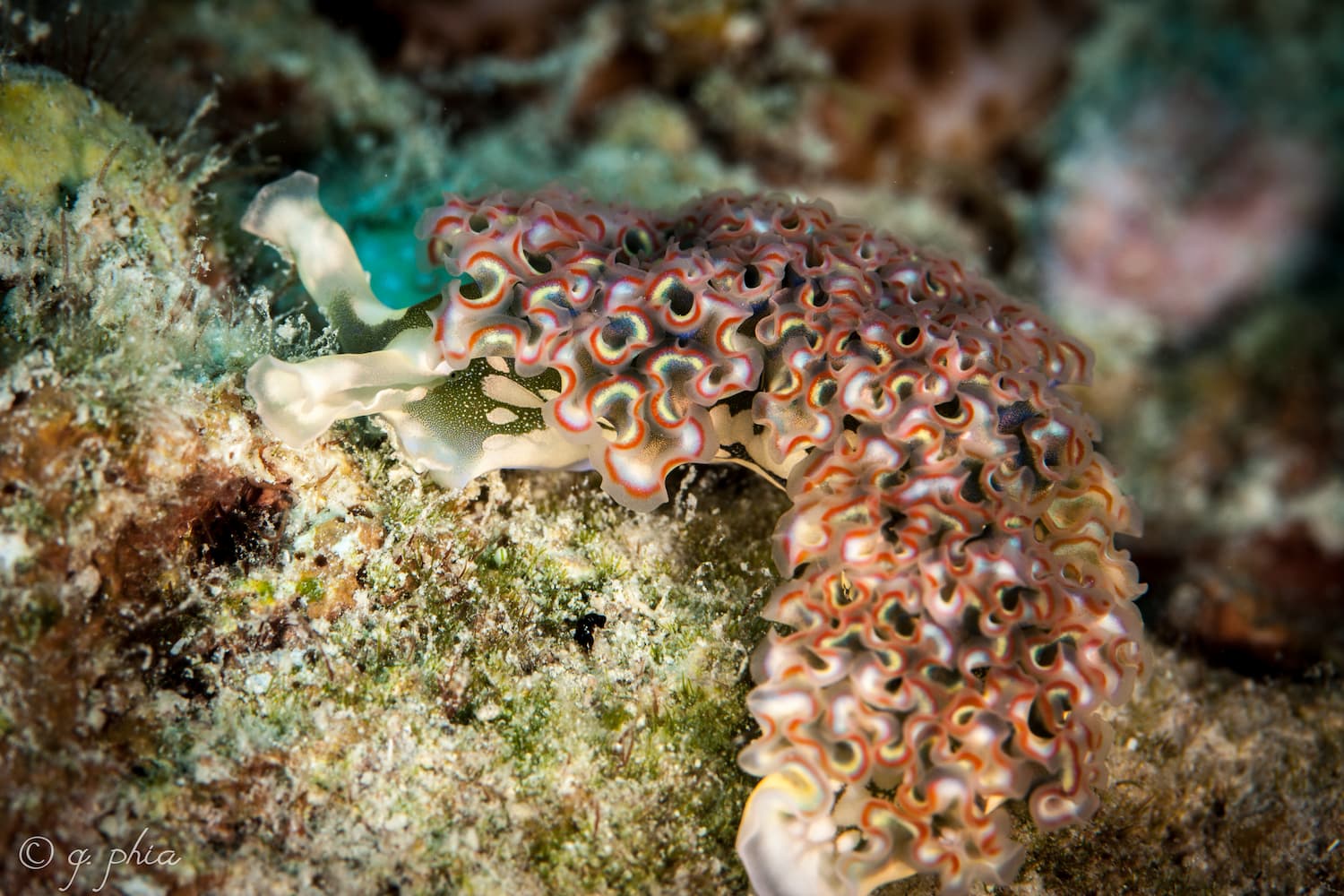
Photo: q phia (https://www.flickr.com/people/60477809@N03)
The lettuce of the sea
The most studied species is Elysia crispata, known as the lettuce sea slug for the wavy folds of its body. It lives on shallow reefs and in shallow waters across the Caribbean, grazing on macroalgae in full daylight.4
Its coloration works as a dietary calling card: the animal’s tone shifts with the algal species it has eaten, so individuals of the same species can appear in deep greens, bluish hues or yellowish tints.4 The genus Elysia includes many species spread across tropical and temperate seas, and they do not all hold on to chloroplasts for the same length of time: in some the theft lasts days; in others, months.2
What an internal sun is good for
Cartaxana and Cruz’s review sums up the ecological role of kleptoplasty: stolen photosynthesis can sustain the animal when food runs short, supplementing its diet with home-grown sugars. On a reef where available algae shift with the season, carrying a built-in solar reserve can mean the difference between surviving and not surviving.2
There is also an optical effect. A slug loaded with green chloroplasts, motionless on a green alga, blends into its own meal. The theft feeds and camouflages at once.2
The animal that looks like a leaf
At midday, when vertical light penetrates the shallow water, Elysia crispata spreads its parapodia (fleshy wing-like extensions on the sides of its body) and increases the surface exposed to the sun. For a while, the animal stops looking like an animal: it is a green sheet breathing light, a leaf that decided to have feet.
No other known animal does this in a stable way. Sacoglossan slugs found an evolutionary shortcut that science is still taking apart piece by piece: rather than building photosynthetic machinery of their own, steal it ready-made and learn to keep it alive.
A question for the reader
If an animal can run for months on organs stolen from an alga, where does the animal end and the plant begin? Next time you see a leaf moving slowly, ask yourself: who is doing the photosynthesis in there?
Sources
Methodological note: chloroplast retention time varies by species and study; we used the range “from days to months” to avoid fictitious precision. The role of kleptoplasty in survival during food scarcity is presented as an ecological hypothesis discussed in the cited review, not as a fact measured across all Elysia species.
Footnotes
-
Wikipedia, “Kleptoplasty”, consulted July 10, 2026. https://en.wikipedia.org/wiki/Kleptoplasty [Secondary; medium] ↩ ↩2 ↩3 ↩4
-
Cartaxana, P. & Cruz, S., “Kleptoplasty: photosynthesis in the sea slug Elysia crispata”, in Reference Module in Life Sciences, Elsevier (2020). DOI: 10.1016/B978-0-12-809633-8.90675-3. [Review; high] ↩ ↩2 ↩3 ↩4 ↩5
-
Rey et al., “Preservation and remodelling of chloroplast lipids in photosynthetic sea slug host cells”, Frontiers in Marine Science (2026). https://www.frontiersin.org/journals/marine-science/articles/10.3389/fmars.2026.1844230/full [Primary; high reliability] ↩
-
Wikipedia, “Elysia crispata”, consulted July 10, 2026. https://en.wikipedia.org/wiki/Elysia_crispata [Secondary; medium] ↩ ↩2
Topics
Newsletter
A weekly reading to see the aquatic world with clearer judgment.
Receive short, carefully edited reflections on aquatic life, ethical aquarium keeping, and applied science.
Subscribe