

Terra Nova: Scott's ghost revealed in 3D off Greenland
Ten nautical miles off southern Greenland, the wooden hull of the ship that carried Scott to Antarctica sits intact in the half-dark. An international expedition is now building its digital twin before the sea erases it.
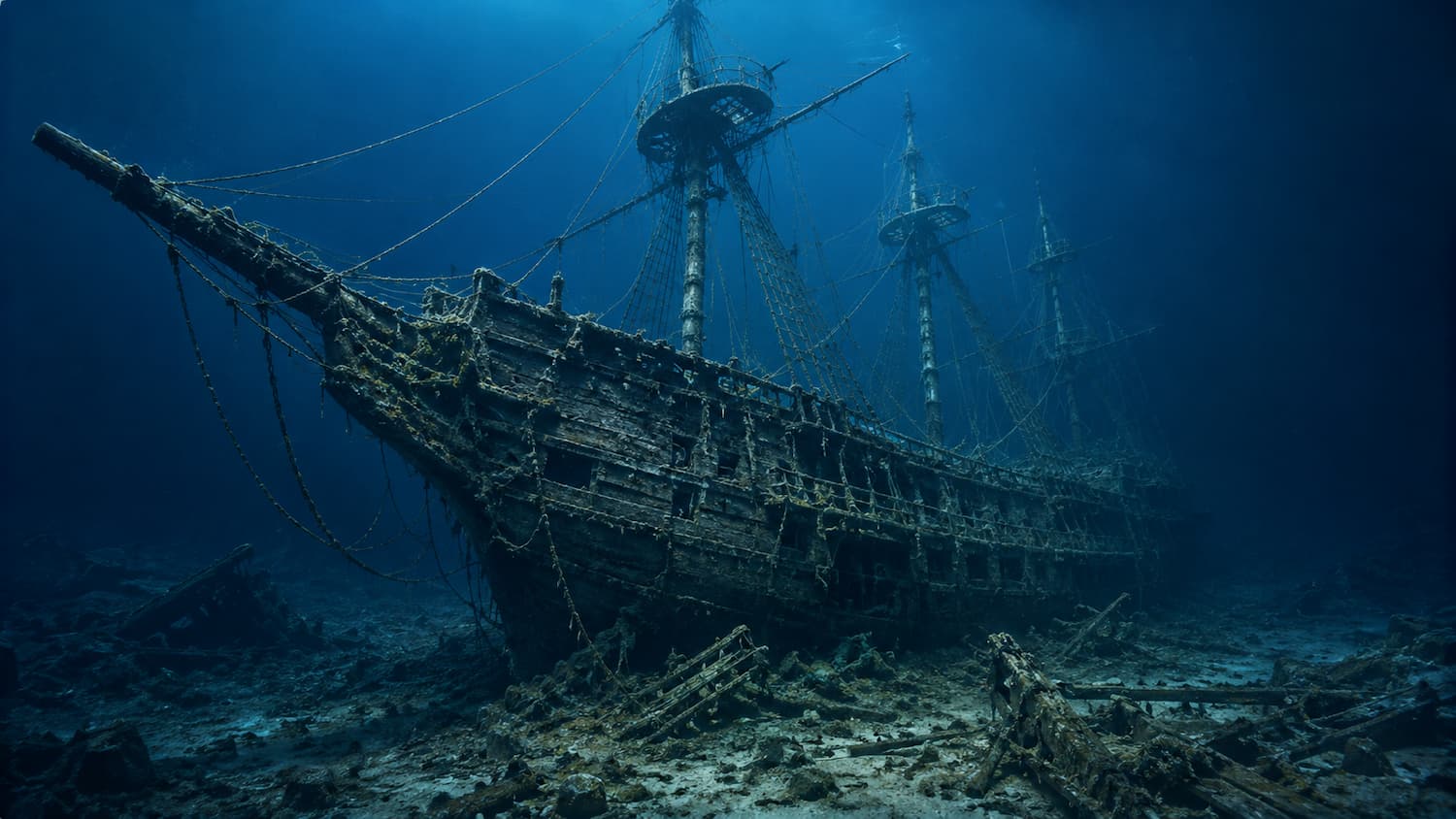
Photo: AI generated
The ROV’s (remotely operated vehicle’s) lights move slowly across the floor of the North Atlantic. At that depth and that latitude, the water is the color of ink. Then the beam grazes one curved line, then another, and suddenly the support ship’s screen shows what no human eye had seen in this detail for more than eighty years: the wooden frames of a vessel built in Dundee in 1884, resting on her side, her bow split open, her double rudder still in place.1
She is the Terra Nova. The ship that carried Robert Falcon Scott to Antarctica in 1910 and came home without him. Sunk by the United States Coast Guard itself in September 1943, ten nautical miles off the southern coast of Greenland, she waited eight decades for someone to descend with cameras good enough to tell her whole story.12
A ship with three lives
Few hulls hold as many eras inside them as this one. Terra Nova was launched in 1884 from the yards of Dundee, Scotland, a city that then lived on jute (a plant fiber used for rope and sacking) and on reinforced wooden whaling ships. She was not built for glory: she was built to endure ice.2
Her first life was polar. After serving in the relief effort for the Discovery expedition, the ship became the flagship of the Terra Nova expedition (1910-1913), the one that took Scott and his men to the Ross Ice Shelf for the final push toward the South Pole. Scott and four companions reached the pole in January 1912, found Amundsen’s Norwegian flag already planted there, and died on the way back. The ship waited, picked up the survivors, and carried home the news that moved the world.2
Her second life was grey and workaday. Terra Nova returned to what she had known since the shipyard: working in ice. She spent years in the Newfoundland sealing industry, hauling pelts and weathering storms, a trade without epic but with the same old ice.2
Her third life was wartime. During the Second World War, the United States chartered her to supply the bases in Greenland, that vast strategic board between America and Europe. In September 1943, damaged and taking on water off the island’s southern coast, she was deliberately sunk by the U.S. Coast Guard. The ship that had survived Antarctica ended her days as a navigational hazard that had to be sent to the bottom.12
The expedition that went down to look at her
In July 2026, an international expedition led by the Royal Canadian Geographical Society and the Woods Hole Oceanographic Institution returned to the sinking site with an aim different from a photographic salvage: to document the wreck before it disappears.134
The team worked with two complementary vehicles. The ROV Falcon, operated by Woods Hole, swept the hull with photogrammetry systems (techniques that reconstruct three-dimensional geometry from overlapping photographs) from the Canadian company Voyis, capable of reconstructing the wreck’s geometry from thousands of overlapping images. The crewed submersible Alvin, also from Woods Hole, allowed direct observation of the site.13
The wooden hull remains intact. The bow appears split, probably from the impact with the seabed or from damage sustained before the sinking, but the whole preserves an astonishing legibility: the double rudder is still visible, the propeller still on its shaft, the ship’s lines recognizable at first glance. Eighty years of cold water and darkness have preserved what air and time would have undone decades ago.1
John Geiger, chief executive of the Royal Canadian Geographical Society, has underlined the historical value of a wreck that connects directly with the heroic age of polar exploration and with the maritime history of Newfoundland. The expedition, named the Heroic Age Expedition, takes its title precisely from that period when the poles were the last cartographic frontier on Earth.4
The digital twin against oblivion
Voyis photogrammetry does not produce only photographs. Every pass of the ROV adds data to a high-resolution three-dimensional model: a digital twin of the wreck that will let researchers study it, measure it, and move through it without getting wet.1
The logic is the same that governs the most advanced underwater archaeology today: the digital document will outlive the physical object. Deep-water wooden wrecks are not eternal. Corrosion loosens the ironwork, boring organisms work the timber, the hull’s own weight settles into the sediment. The question is not whether Terra Nova will disintegrate, but when, and whether by then a sufficiently precise record of what she was will exist.1
There is something moving in that technological race against dissolution. A ship that served three distinct eras (heroic exploration, the cold-water industry, total war) is going to be archived as pure geometry: millions of points in space reconstructing every treenail (a wooden peg used in shipbuilding) and every plank. Anyone who can never descend to that seafloor will still be able to travel across it.34
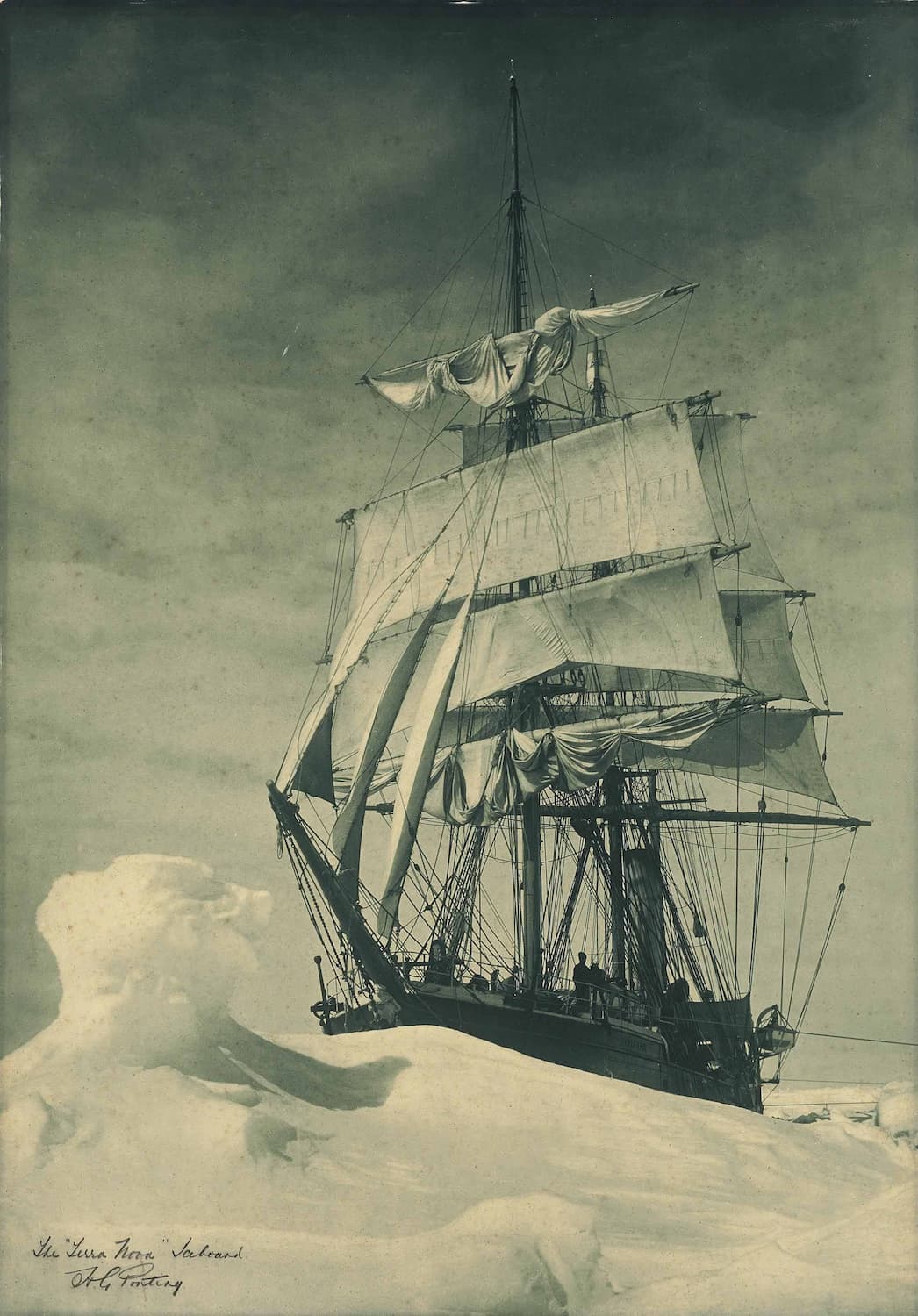
Photo: Herbert George Ponting
What a wreck keeps
At Acquario di Bologna we look at water as a medium that keeps memory. A home aquarium preserves a fragment of ecosystem; the deep ocean preserves fragments of history. The seafloor off Greenland is not only sediment and cold-water fish: it is an archive where a hull of Scottish oak and pine has spent eighty years waiting for readers.
Terra Nova is not the deepest wreck, nor the oldest, nor the most famous. She is something else: a point where three different ways in which the nineteenth and twentieth centuries related to the sea converge. The first, romantic and terrible, drove men like Scott to walk until death to reach a geographic point before anyone else. The second, industrial and routine, used wooden ships as extraction tools. The third, strategic, turned them into pieces of a global war that ended up sinking them when they got in the way.
That the hull is intact is what allows that triple biography to be read in a single pass. A broken-up wreck would be only scattered timber. A whole wreck is a book.
A question for the reader
The next time you look at still water, in an aquarium, in a harbor, on the open sea, ask yourself: what stories are waiting beneath the surface, and what responsibility do we have to document them before the water erases them?
Sources
Methodological note: the technical details of the 3D survey and the institutional statements come from the cited sources. Where sources give no concrete figures (exact wreck depth, number of dives), we have chosen not to invent precision.
Footnotes
-
Milligan, “Expedition unveils first detailed images of Robert Falcon Scott’s final ship - Terra Nova”, HeritageDaily, July 14, 2026. https://www.heritagedaily.com/2026/07/expedition-unveils-first-detailed-images-of-robert-falcon-scotts-final-ship-terra-nova/158606 [Secondary; high reliability] ↩ ↩2 ↩3 ↩4 ↩5 ↩6 ↩7 ↩8
-
“Terra Nova (ship)”, Wikipedia (English edition), consulted July 2026. https://en.wikipedia.org/wiki/Terra_Nova_(ship) [Secondary; medium. Historical context: Dundee construction 1884, Discovery expedition, Terra Nova expedition 1910-1913, sealing industry, U.S. charter in the Second World War, and 1943 sinking.] ↩ ↩2 ↩3 ↩4 ↩5
-
Woods Hole Oceanographic Institution, operator of the ROV Falcon and the submersible Alvin. https://www.whoi.edu/ [Primary; high] ↩ ↩2 ↩3
-
Royal Canadian Geographical Society, the institution leading the Heroic Age Expedition. https://rcgs.org/ [Primary; high] ↩ ↩2 ↩3
Topics
Newsletter
A weekly reading to see the aquatic world with clearer judgment.
Receive short, carefully edited reflections on aquatic life, ethical aquarium keeping, and applied science.
Subscribe