

The ama: the sea women who have been free-diving for 2,000 years
On the Ise-Shima peninsula, a few dozen elderly women still dive on a single breath to gather abalone, sea urchins and seaweed. Their craft, documented for two millennia, is today both cultural heritage and a practical lesson in marine sustainability.
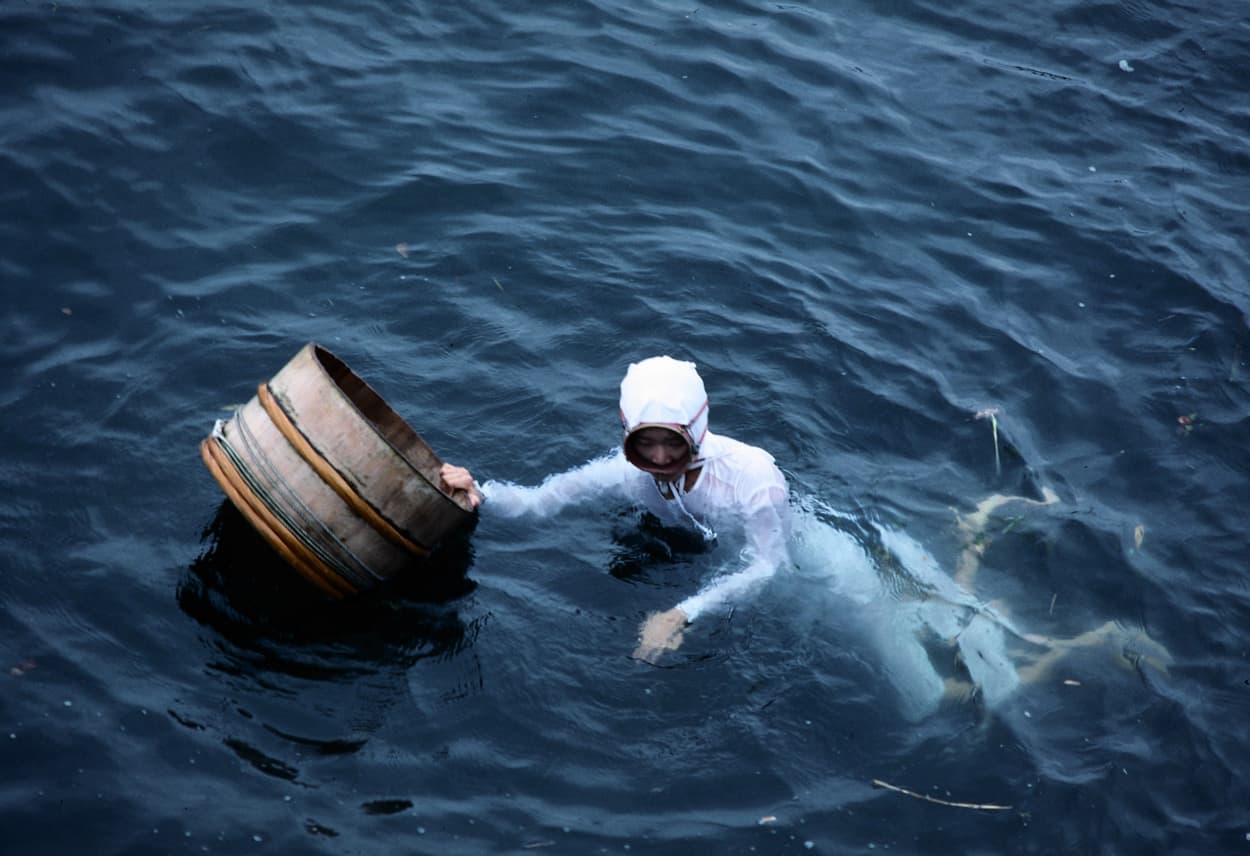
Photo: H. Grobe (CC BY 3.0)
Early in the morning, while the bay of Toba still holds its mist, a woman in her seventies rises out of the grey-green water. A long, modulated whistle cuts through the salty air. It is the isobue, the whistling breath that ama divers release as they surface after a minute underwater. In her hand, an abalone (a large marine gastropod mollusk, highly valued for its meat and shell). Around her, the coastline of the Ise-Shima peninsula in Mie Prefecture, the last stronghold of a tradition that has been practiced in these waters for close to two thousand years.1
She carries no tank. No regulator, no dive computer. She carries a mask, fins, a suit and a mesh net. And a way of working that has passed from mothers to daughters since before written records existed.
What it means to be ama
The word ama (海女) is written with two characters: “sea” and “woman.” It designates the Japanese divers who free-dive (dive without breathing apparatus) to gather shellfish and seaweed: abalone, sea urchins, sea cucumbers, oysters and, in their day, pearl oysters. The tradition is documented for roughly two thousand years, and the earliest Chinese and Japanese written records already described women descending to the seabed in search of shells.1
Although there were historically male divers as well (sometimes called katsugi or male ama in certain regions), the craft became decisively associated with women. Traditional explanations point to a better distribution of body fat, which would protect against the cold during long immersions, and to a coastal division of labor in which men went out to fish offshore while women worked the grounds close to shore.1 The outcome is undeniable: in Japan, the face of professional free-diving is a woman’s face.
A trade, not a folklore
The ama are not an ethnographic spectacle. They are sea professionals who extract high-value products under strict regulations on season, minimum size and catch area. Abalone in particular commands high prices on the Japanese market, and the divers’ harvest is limited to certain months of the year to protect the species’ reproduction.2
Traditionally they worked dressed in a white cotton suit (the isogi), which, according to local belief, kept sharks away and made the divers easier to see from the surface. Today many wear wetsuits, a practical concession to the cold Pacific, although in some communities the traditional clothing is kept for cultural demonstrations.12
Each dive lasts between thirty seconds and just over a minute. They descend to depths usually between five and twenty meters, locate their prey among the rocks, prise it loose with a metal tool and ascend. On surfacing, the isobue: a whistling exhalation that regulates breathing after the apnoea (the period of breath-holding) and has become the craft’s sonic signature.1
They work in pairs or small groups. Some set off from the shore with a float (kachido); others drop vertically from a boat, helped by a counterweight (funado). After several hours in the water, they return to the harbor hut (the amagoya), where they warm themselves by a fire, eat and share the day’s work.1
The quiet lesson of sustainability
What makes the ama relevant to a magazine about aquatic life is not only the age of the tradition but the model of extraction it represents. Diving on a single breath imposes a physical limit that cannot be broken: you cannot stay down longer than the body allows. That physiological constraint, combined with community rules on seasons and resting grounds, has worked for centuries as a low-impact fisheries management system.13
The ama do not strip the seabed. They take what they can see and prise loose in sixty seconds, and leave the rest. The grounds they work have been producing for centuries without collapsing, something few industrial fisheries can claim. At a time when overfishing is one of the ocean’s main threats, this craft offers a practical lesson: sustainability does not always require sophisticated technology; sometimes it requires limits, patience and accumulated local knowledge.3
The last generation
And yet the ama are disappearing. A few decades ago several thousand divers worked the Japanese coasts; by 2006, international correspondents were already warning that the craft was ageing without successors, and the figures of the time spoke of around six thousand active ama, most of them over fifty.4 Recent reporting describes communities where the remaining divers can be counted in the dozens, and where the average age is well past sixty.23
The causes are well known and hard to reverse. The ama’s daughters and granddaughters study, move to the cities, and take up better-paid, less punishing work. Free-diving is demanding: cold water, sustained physical effort, irregular income tied to the season. At the same time, the sea itself is changing: shifts in water temperature and the decline of some shellfish populations complicate the trade’s economic viability.23
Some communities have responded with preservation programs: registering the craft as cultural heritage, training schools for interested young women, observation tourism at the amagoya. The city of Toba and the Ise-Shima region have become the symbolic center of this resistance, with veteran divers who combine real fishing with the transmission of knowledge.2 But even those working on preservation admit that the goal is no longer so much to perpetuate commercial fishing as to keep alive the memory of a way of relating to the sea.
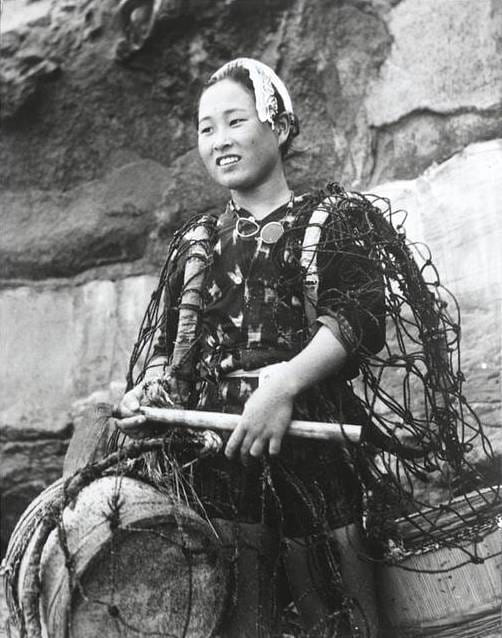
Photo: 岩瀬禎之
The whistle in the mist
Back to the opening scene. The woman in her seventies drops the abalone into her basket, adjusts her mask and breathes. In the harbor hut, other women of her age talk over the day’s catch beside the fire. None of them considers herself a relic. They consider themselves what they are: sea workers who learned a trade from their mothers and have practiced it for half a century.
The next time we hear about “thousand-year-old fishing traditions,” it is worth remembering that we are not talking about a remote past, but about specific people who today, this morning, went into the water. A tradition is not a thing: it is a practice that someone decides to continue every day. And every day an ama dives, that decision is renewed one time fewer.
A question for the reader
If a trade that is sustainable with the sea can last two thousand years and vanish in two generations, what are we willing to learn from it before it becomes only memory?
Sources
Methodological note: figures on the number of active divers vary by source and year; descriptive ranges (“several thousand”, “dozens”) have been used to avoid false precision. No individual divers are named, both for editorial respect and because the consulted sources do not document them verifiably.
Footnotes
-
“Ama (diving)”, Wikipedia (English edition), accessed 2025. [General reference; high reliability] ↩ ↩2 ↩3 ↩4 ↩5 ↩6 ↩7
-
“Japan’s last female Ama pearl divers”, BBC Travel, 28 February 2020. [Secondary; high] ↩ ↩2 ↩3 ↩4 ↩5
-
“The Plight of Japan’s Ama Divers”, Nautilus, 15 March 2024. [Secondary; medium] ↩ ↩2 ↩3 ↩4
-
Justin McCurry, “Ancient art of pearl diving breathes its last”, The Guardian, 24 August 2006. [Secondary; high] ↩
Topics
Newsletter
A weekly reading to see the aquatic world with clearer judgment.
Receive short, carefully edited reflections on aquatic life, ethical aquarium keeping, and applied science.
Subscribe