

The sword the sea off Devon kept for three thousand years
Volunteer divers have recovered a roughly 3,000-year-old bronze sword from the protected wreck sites of Salcombe, off south Devon. Together with more than 400 gold objects, axes and ingots, the find turns the western Channel into a Bronze Age trade route.
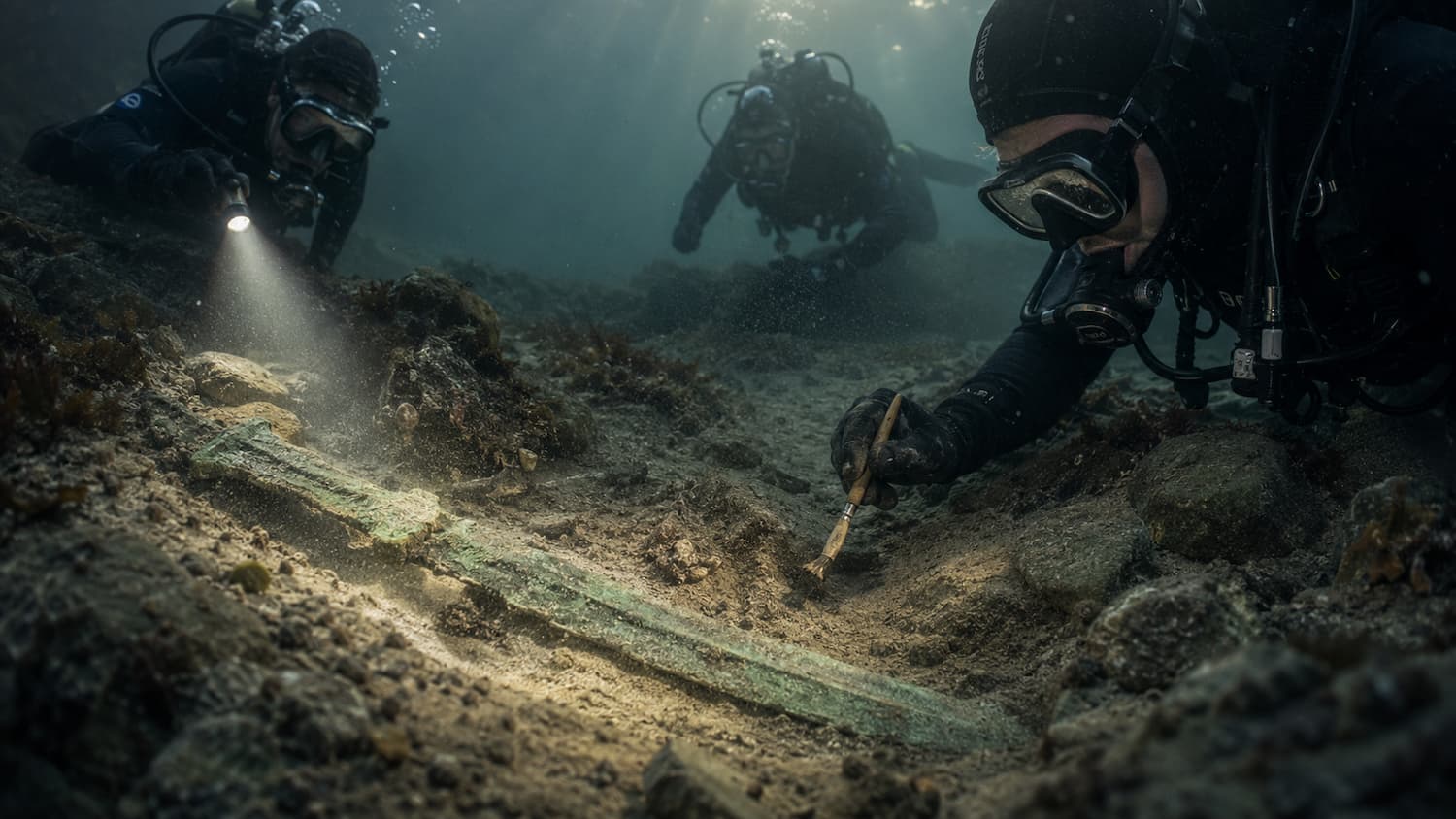
Photo: AI generated
The water off south Devon is cold even in summer: green, thick, with visibility that forces you to work almost by touch. On that seabed of sand and rock, a gloved hand moved sediment aside and found metal. It was not the remains of a modern ship or ammunition from a recent war, but a bronze sword made between 1300 and 800 BC. An object that had gone nearly three thousand years without being held by anyone.1
The divers who recovered it, Becky Gill and Catherine Gill, do not work for a salvage company. They are volunteers with the South West Maritime Archaeological Group, a team that surveys these waters with funding from Historic England.12 Their find is no isolated stroke of luck either: it is the most recent piece of an assemblage this seabed has been giving back for years, object by object.
A seabed that gives objects back
The Salcombe Cannon and Moor Sand sites belong to Britain’s Protected Wreck Sites, wrecks with legal protection comparable to that of a national monument. Historic England designates and funds them as Scheduled Monuments, the category the United Kingdom reserves for its most sensitive archaeological remains.3 Beneath that sand, more than four hundred Bronze Age objects have come to light: gold pieces, axes, metal ingots (bars of raw metal, typically cast for transport) and bracelets.13
The archaeological reading of the assemblage points to one or two wrecks: merchant vessels carrying metal and worked objects that never reached harbor. The sea barely preserved the wood, but it kept the cargo. Every axe and every ingot sketches the outline of a trade that, without this seabed, would be invisible. No commercial treaties survive from that era, no cargo lists. What survives is the cargo itself, sunk.
Legal protection matters here as much as the trowel. A Bronze Age wreck is not treasure to be divided up; it is a fragile document that one clumsy move can erase forever. The fact that Salcombe’s objects keep coming out of the water in the hands of a registered team, with permits and public funding, is why we can read them today as history rather than loot.23
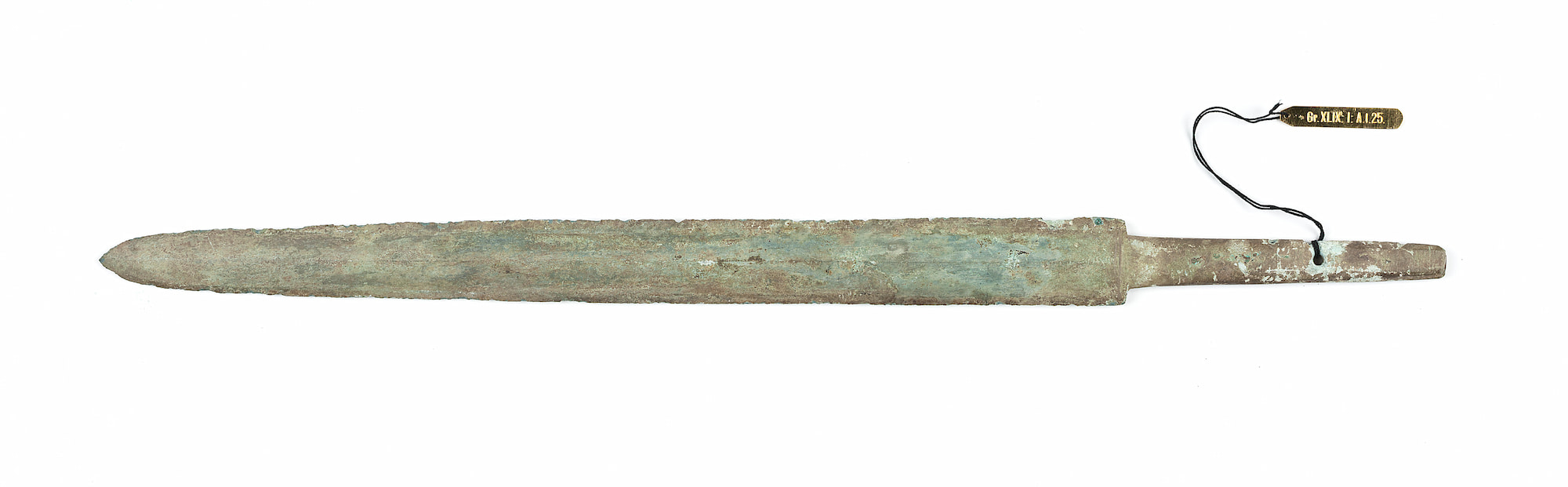
Photo: AI generated
A liquid route older than maps
Salcombe’s importance lies not only in the objects, but in what they demonstrate together. That such a cargo sank off the Devon coast means someone was sailing those waters with valuable goods around three thousand years ago. The assemblage is read as evidence of a maritime exchange network connecting Britain with the far side of the English Channel, three millennia before written navigation.13
From that period there are no chronicles, no logbooks, no maps. The route exists because the objects exist: because the bronze of an axe found on the Salcombe seabed may have been worked far away, and because someone considered it normal to load it onto a vessel and cross open water. The ingots, raw material without form, speak of metal traveling as merchandise; the swords and bracelets, of finished objects that also crossed the sea.
The Channel, which we now read as a border, was then a road. The coastline we see on modern maps did not separate worlds: it joined them, at the pace of oars and primitive sail, with stops dictated by the wind. Every object recovered at Salcombe is a knot in that network, and the newly found sword, one knot more.
From the seabed to the museum
The sword will not return to the water. Its destination is the British Museum, the institution that holds and studies the Salcombe Bronze Age assemblage.14 Neil Wilkin, a curator at the museum, has publicly assessed the find in statements reported by HeritageDaily.1
There the piece will pass from underwater silence to another kind of silence: that of the display case. It will enter a register, be measured, photographed and compared with other swords of its period. It will trade sand for documentation. This is the object’s second journey, and it is also a long one: from the bottom off Devon to a gallery where anyone can look at it from a hand’s breadth away, with no air tank or wetsuit required.
That passage, from sea to museum, is today the only way objects like this survive erosion, looting and oblivion. A protected wreck is not a sealed warehouse: it is an archive consulted slowly, under permit, in the knowledge that what leaves the water cannot go back.
What a hand touches
There is something hard to explain about the moment a present-day hand touches an object no one had touched for three thousand years. The Salcombe sword was in another hand before it sank: someone gripped it, carried it, lost it with the ship. Between that hand and the divers’ hands there are no documents. Only time.
That is why it matters who found it. Not a robot, not an industrial dredge, but two volunteers who devote their dives to slow, recorded, publicly funded work.123 British underwater archaeology depends heavily on teams like this: people who dive out of conviction and hand what they find over to the common heritage. Without them, the Salcombe seabed would still be only sand.
The Celtic Sea and the western Channel still hold much of that story. The sword is one more sign that the seabed is not a void: it is an archive waiting for the right conditions, patience and trained hands. Three thousand years are nothing to the sea. They are everything to us, who live only a tiny fraction of that span and yet can, for an instant, hold it.
A question for the reader
If a sword can wait three thousand years beneath the sand until someone picks it up, what other stories are still sailing beneath the routes we think we know?
Sources
Methodological note: the dating of the sword (1300-800 BC), the figure of more than four hundred objects and the interpretation of the site as one or two Bronze Age wrecks come from the HeritageDaily report and the current reading by the teams involved; the interpretation may be revised by future studies.
Footnotes
-
Milligan, M., “Divers uncover Bronze Age sword off south Devon coast”, HeritageDaily, 2026-07-18. Report on the recovery by Becky Gill and Catherine Gill, funded by Historic England, with statements by Neil Wilkin. [Secondary; high] ↩ ↩2 ↩3 ↩4 ↩5 ↩6 ↩7
-
South West Maritime Archaeological Group, Salcombe Cannon / Moor Sand project, 2026. Volunteer team leading the underwater survey. [Primary; high] ↩ ↩2 ↩3
-
Historic England, Protected Wreck Sites: Salcombe Cannon and Moor Sand, 2026. Institution that funds and protects the sites as Scheduled Monuments. [Primary; high] ↩ ↩2 ↩3 ↩4 ↩5
-
British Museum, Salcombe Bronze Age hoard; Neil Wilkin, curator, 2026. Institution receiving the piece. [Primary; high] ↩
Topics
Newsletter
A weekly reading to see the aquatic world with clearer judgment.
Receive short, carefully edited reflections on aquatic life, ethical aquarium keeping, and applied science.
Subscribe