

Vallisneria spiralis: living card for a tape plant
An atlas card for using Vallisneria as a living background: runners, current, correct trimming, mineralized water, and lengthwise space.
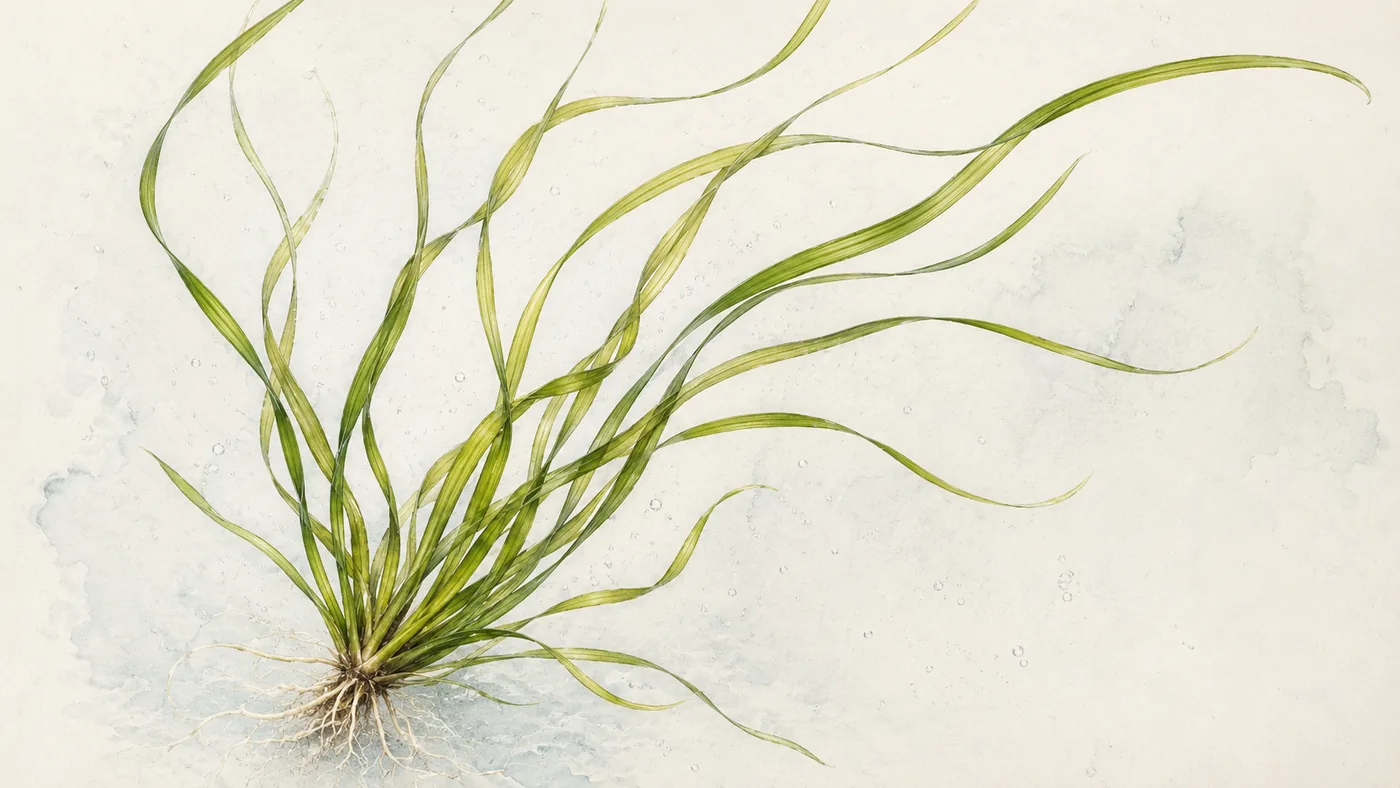
Vallisneria spiralis (vallisneria) adds vertical motion and refuge, but it is not decorative ribbon. It grows, sends runners, and changes circulation.
Quick read
- Type: runner-forming tape plant.
- Aquarium: background of medium or large aquariums.
- Indicative temperature: 20-28 C.
- pH: 6.5-8.0.
- Light: medium.
- CO2: optional.
- Planting: crown just above substrate; do not bury the centre.
- Difficulty: low-medium; can spread by runners.
What to check before planting
Choose firm crowns and white or pale roots. Cut leaves can recover; rotten centres cannot.
During adaptation, old leaves may die back while new shoots appear in a different form. Judge the growth point, not a perfect old leaf.
Planted-tank design
Plant along the background with room for runners. Prune leaves from the base when possible, not like mowing grass.
The right position prevents future work: slow plants under less light, stem plants with trimming margin, and large plants where they do not block the whole aquarium.
Working parameters
It does better in mineralized water. Sudden changes, treatments, or strong liquid carbon can melt leaves.
The plant responds to light, carbon, nutrients, flow, and stability, not to labels like low-tech or high-tech. Change one variable at a time so you can see what worked.
Compatibility and warning
Good with schooling fish and livebearers. Diggers or fish that pull leaves may uproot young runners.
Mass melt after chemical changes or persistently transparent leaves call for checking treatments, light, and root nutrition.
Reference sources
Tropica Aquarium Plants and Kew Plants of the World Online for culture, growth type, and botanical reference. Ranges are indicative and depend on light, nutrients, CO2, and the plant’s original growth form.
Topics
Newsletter
A weekly reading to see the aquatic world with clearer judgment.
Receive short, carefully edited reflections on aquatic life, ethical aquarium keeping, and applied science.
Subscribe