

Taxiphyllum barbieri: living card for Java moss
An atlas card for using Java moss without turning it into a debris trap: trimming, attachment, gentle flow, and microfauna refuge.
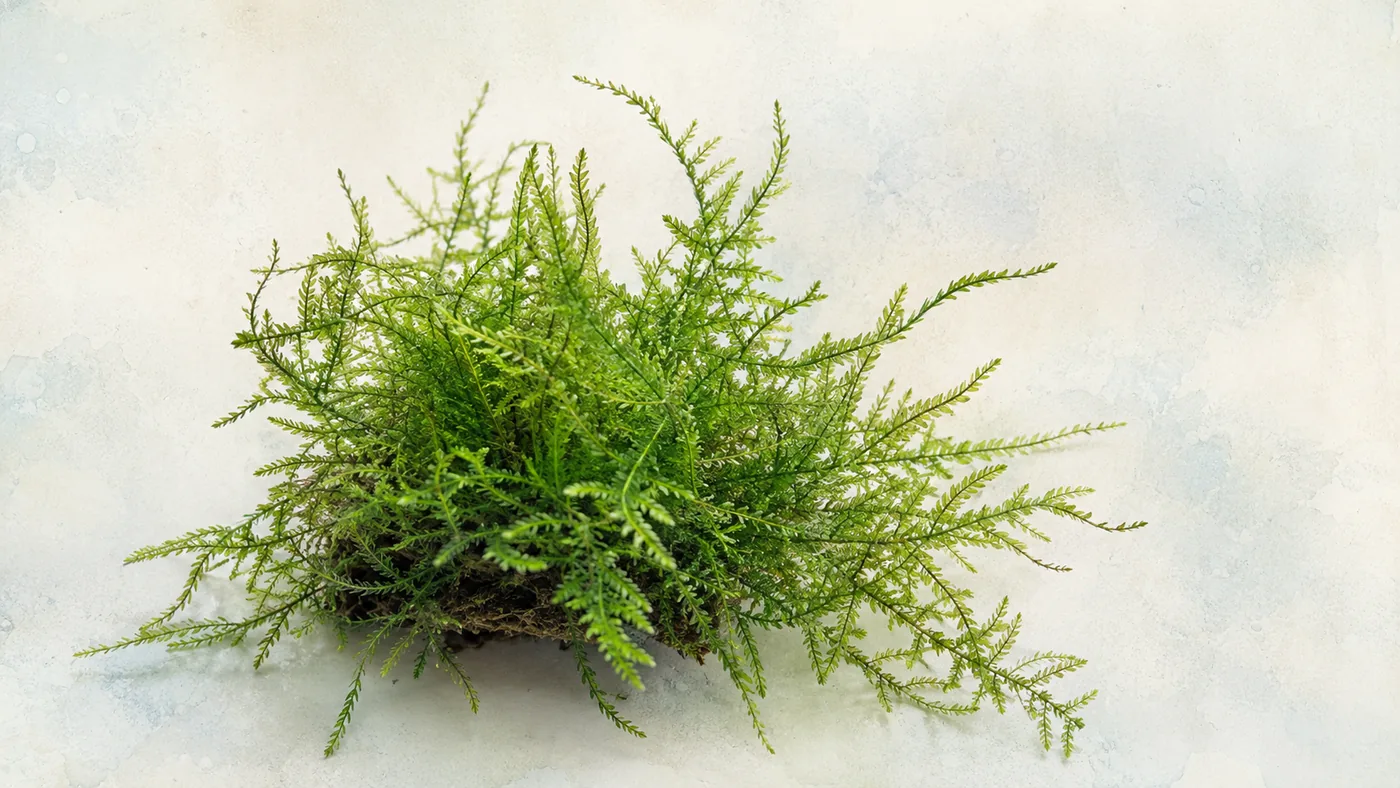
Taxiphyllum barbieri (Java moss) gives shrimp, fry, and microfauna a dense refuge. Left alone, the same mass traps debris and smothers its base.
Quick read
- Type: adaptable aquatic moss.
- Aquarium: nano, breeding, shrimp, or low-demand planted tank.
- Indicative temperature: 18-28 C.
- pH: 6.0-7.8.
- Light: low to medium.
- CO2: optional.
- Planting: tie until attached; trim dense layers.
- Difficulty: low; maintenance matters more than starting.
What to check before planting
Look for green portions without decay smell or too much hair algae mixed in. Rinse with aquarium water before attaching.
During adaptation, old leaves may die back while new shoots appear in a different form. Judge the growth point, not a perfect old leaf.
Planted-tank design
Use it in thin layers on wood or rock. In shrimp tanks, leave open space for maintenance and feeding.
The right position prevents future work: slow plants under less light, stem plants with trimming margin, and large plants where they do not block the whole aquarium.
Working parameters
It tolerates broad ranges but grows better with clean water and some nutrients. Gentle flow prevents particle buildup.
The plant responds to light, carbon, nutrients, flow, and stability, not to labels like low-tech or high-tech. Change one variable at a time so you can see what worked.
Compatibility and warning
Excellent with shrimp and fry. Large fish, goldfish, or cichlids may tear it loose or scatter it everywhere.
A brown base, bad smell, or dirt cloud when touched indicates too much mass and too little trimming.
Reference sources
Tropica Aquarium Plants and Kew Plants of the World Online for culture, growth type, and botanical reference. Ranges are indicative and depend on light, nutrients, CO2, and the plant’s original growth form.
Topics
Newsletter
A weekly reading to see the aquatic world with clearer judgment.
Receive short, carefully edited reflections on aquatic life, ethical aquarium keeping, and applied science.
Subscribe