

Microsorum pteropus: living card for Java fern
An atlas card for using Java fern correctly: exposed rhizome, lower light, slow leaves, and attachment to wood or rock.
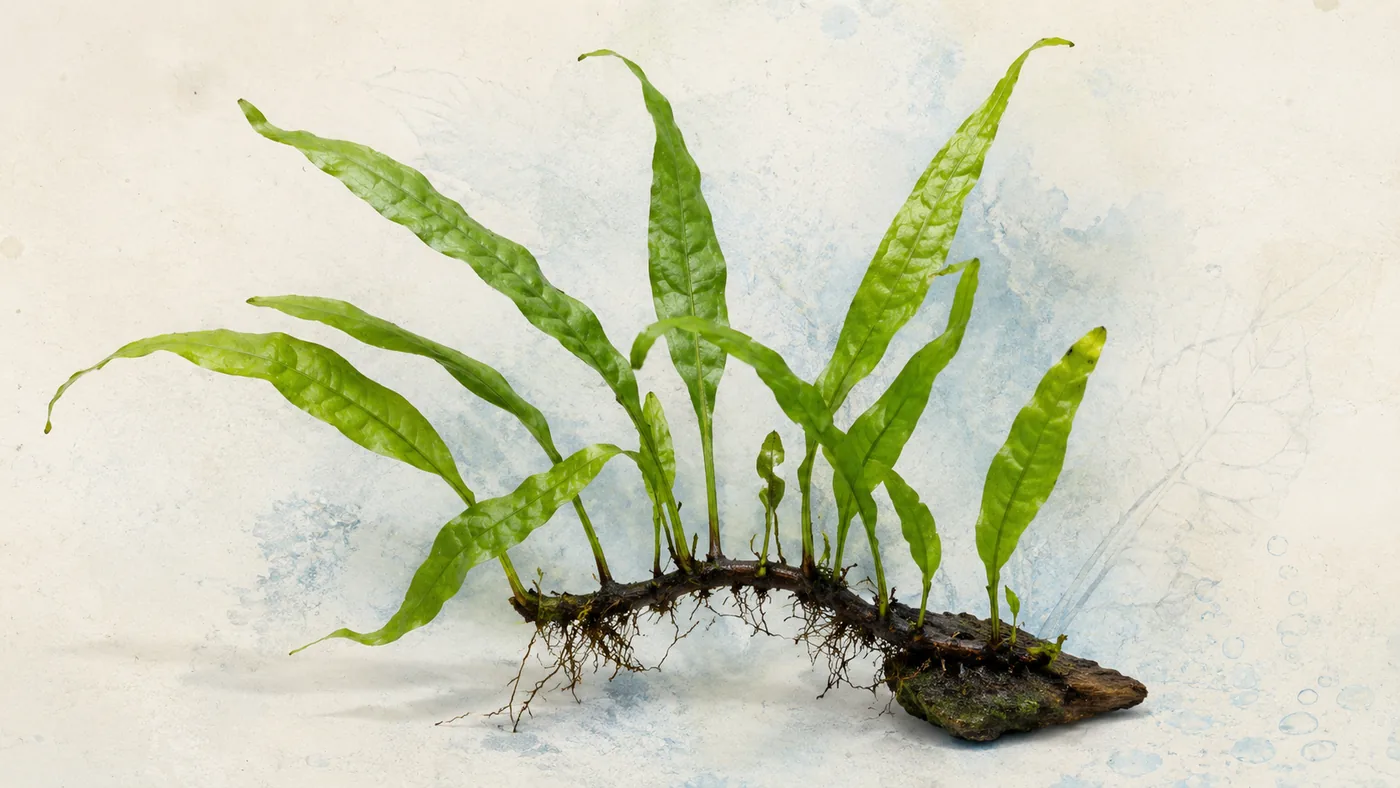
Microsorum pteropus (Java fern) belongs on rock or wood, not under substrate. Tropica’s description, easy and decorative on hardscape, summarizes almost all of its care.
Quick read
- Type: aquatic rhizome fern.
- Aquarium: low-tech, community, or shaded planted tank.
- Indicative temperature: 20-28 C.
- pH: 6.0-7.8.
- Light: low to medium.
- CO2: optional.
- Planting: tie or glue to hardscape; do not bury rhizome.
- Difficulty: low; requires patience.
What to check before planting
Look for a green, firm rhizome. Isolated black tips or sori on adult leaves are not always disease.
During adaptation, old leaves may die back while new shoots appear in a different form. Judge the growth point, not a perfect old leaf.
Planted-tank design
Use it on sides, wood, or partial shade. Under intense light, old leaves collect algae before new mass appears.
The right position prevents future work: slow plants under less light, stem plants with trimming margin, and large plants where they do not block the whole aquarium.
Working parameters
It does not need nutrient substrate because it is not planted in the ground. It needs clean water, water-column nutrients, and time.
The plant responds to light, carbon, nutrients, flow, and stability, not to labels like low-tech or high-tech. Change one variable at a time so you can see what worked.
Compatibility and warning
Its tough leaves resist better than many plants, but digging fish can detach it before it anchors.
If the rhizome softens, check burying or debris. If only old leaves decline, prune and wait for new growth.
Reference sources
Tropica Aquarium Plants and Kew Plants of the World Online for culture, growth type, and botanical reference. Ranges are indicative and depend on light, nutrients, CO2, and the plant’s original growth form.
Topics
Newsletter
A weekly reading to see the aquatic world with clearer judgment.
Receive short, carefully edited reflections on aquatic life, ethical aquarium keeping, and applied science.
Subscribe