

Discosoma spp.: living card for mushroom corals
An atlas card for using Discosoma with judgement: low light, gentle flow, slow expansion, and controlled contact with neighbours.
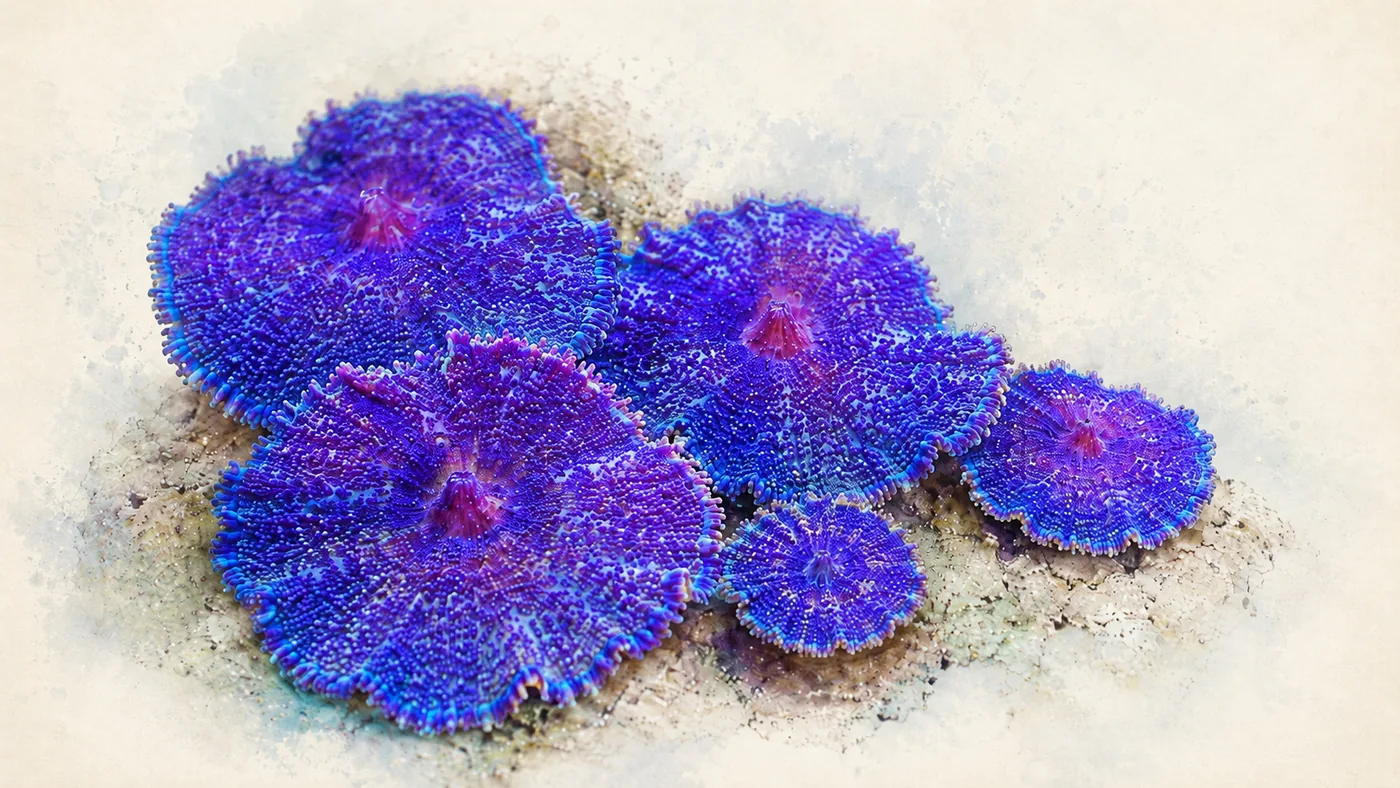
Discosoma spp. (mushroom coral) gives beginner reefs colour and tolerance, but hardiness does not remove the need for placement. Decide where it can expand before it attaches.
Quick read
- Type: photosynthetic corallimorph.
- Aquarium: stable reef, including lower or side zones.
- Light: low to lower-medium.
- Flow: gentle to moderate, never constant direct blast.
- Indicative temperature: 24-26 C.
- Salinity: 1.024-1.026 SG.
- Alkalinity: 8-10 dKH.
- Calcium: 400-450 mg/L.
- Difficulty: low; the challenge is preventing invasion.
What to check before placing it
Choose attached discs with no gaping mouth for hours and no torn tissue. A loose mushroom must be settled gently and patiently.
Before gluing a colony, think about its future size, the direction of flow, and whether you could remove it without dismantling half the rockwork if something goes wrong.
Placement and coral reading
Place it on a secondary rock if you do not want it colonizing the main structure. Too much light can make it shrink or move.
Read the first week outside the blue-light photo. Watch extension, tissue, response to flow, and irritation signs when the aquarium is in its normal rhythm.
Working parameters
It tolerates moderate nutrients and does not require direct feeding. Stable salinity and temperature prevent prolonged contraction.
In a reef, stability means repetition: salinity, alkalinity, temperature, and nutrients inside a window the aquarium can sustain, not perfect numbers from one test.
Compatibility and warning
It can touch or shade slow neighbours. Keep distance from delicate SPS and LPS even if it appears harmless.
A gaping mouth, melting disc, or repeated detachment often indicates too much light, aggressive flow, or instability.
Reference sources
WoRMS for taxonomic reference; LiveAquaria, Tidal Gardens, and specialist reef guides for practical light, flow, and stability ranges. Values are indicative and must be adapted to the real history of the system.
Topics
Newsletter
A weekly reading to see the aquatic world with clearer judgment.
Receive short, carefully edited reflections on aquatic life, ethical aquarium keeping, and applied science.
Subscribe